
Prognostic Weight of FLT3-ITD Allelic Ratio in Newly Diagnosed Acute Myeloid Leukemia
DOI:
https://doi.org/10.5281/zenodo.22818745Keywords:
FLT3-ITD, allelic ratio, acute myeloid leukemia, NPM1, FLT3 inhibitorsAbstract
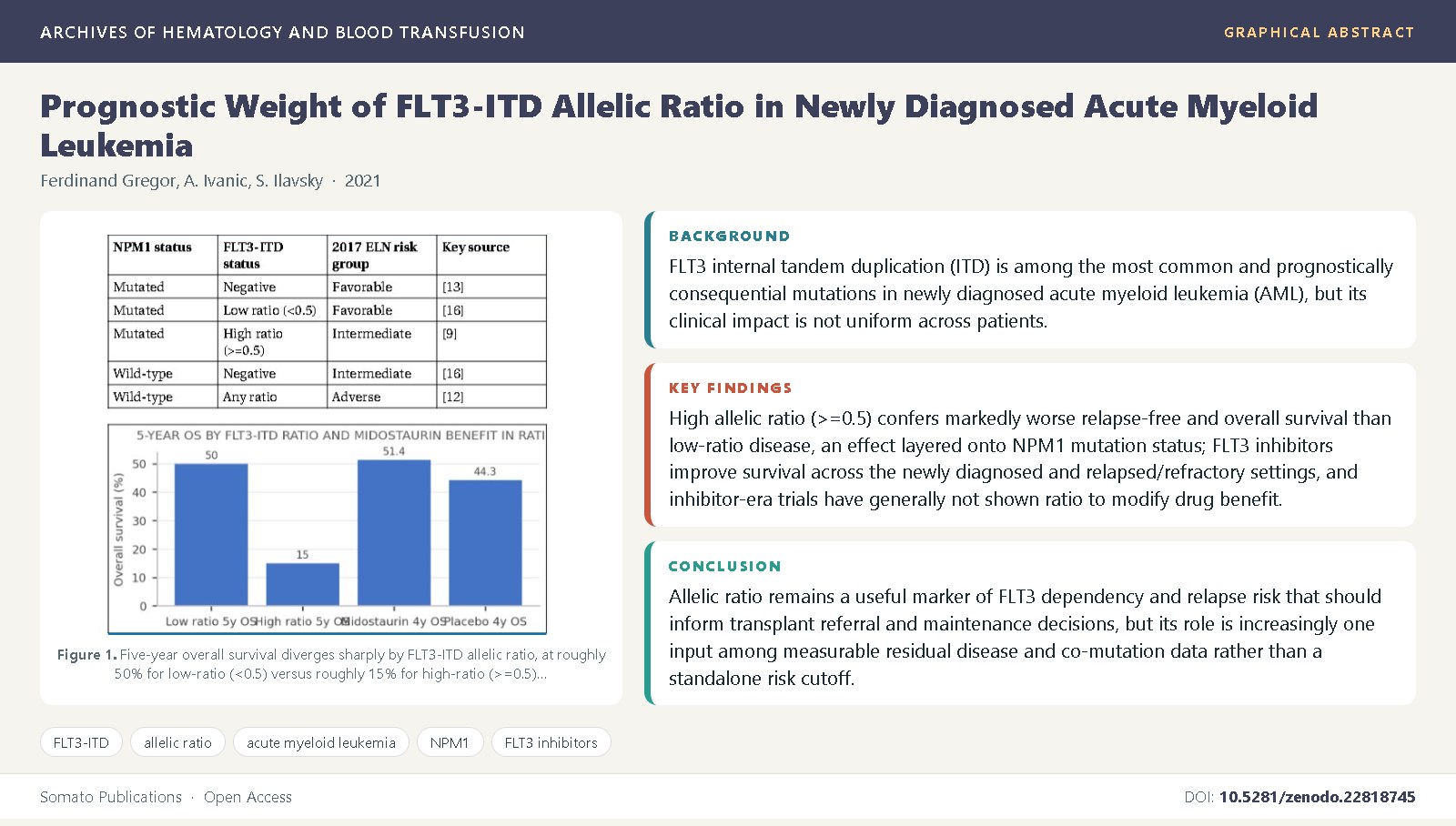
Background: FLT3 internal tandem duplication (ITD) is among the most common and prognostically consequential mutations in newly diagnosed acute myeloid leukemia (AML), but its clinical impact is not uniform across patients.
Objective: To synthesize the published evidence on how the FLT3-ITD mutant-to-wild-type allelic ratio, rather than mutation presence alone, shapes prognosis, interacts with NPM1 co-mutation status, and informs the use of FLT3 inhibitors and allogeneic transplantation.
Methods: Narrative review of landmark cohort studies, European LeukemiaNet risk-classification updates, and randomized phase 3 trials of midostaurin, gilteritinib, quizartinib, and sorafenib in FLT3-mutated AML.
Findings: High allelic ratio (>=0.5) confers markedly worse relapse-free and overall survival than low-ratio disease, an effect layered onto NPM1 mutation status; FLT3 inhibitors improve survival across the newly diagnosed and relapsed/refractory settings, and inhibitor-era trials have generally not shown ratio to modify drug benefit, prompting the 2022 ELN revision that removed the ratio-based split for NPM1-mutated, FLT3-ITD-positive disease.
Conclusions: Allelic ratio remains a useful marker of FLT3 dependency and relapse risk that should inform transplant referral and maintenance decisions, but its role is increasingly one input among measurable residual disease and co-mutation data rather than a standalone risk cutoff.
References
Nakao, M., Yokota, S., Iwai, T., Kaneko, H., Horiike, S., Kashima, K., et al. (1996) Internal tandem duplication of the flt3 gene found in acute myeloid leukemia. Leukemia, 10(12): 1911-1918.
Kiyoi, H., Naoe, T., Nakano, Y., Yokota, S., Minami, S., Miyawaki, S., et al. (1999) Prognostic implication of FLT3 and N-RAS gene mutations in acute myeloid leukemia. Blood, 93(9): 3074-3080. DOI: 10.1182/blood.V93.9.3074
Kottaridis, P.D., Gale, R.E., Frew, M.E., Harrison, G., Langabeer, S.E., Belton, A.A., et al. (2001) The presence of a FLT3 internal tandem duplication in patients with acute myeloid leukemia (AML) adds important prognostic information to cytogenetic risk group and response to the first cycle of chemotherapy: analysis of 854 patients from the United Kingdom Medical Research Council AML 10 and 12 trials. Blood, 98(6): 1752-1759. DOI: 10.1182/blood.V98.6.1752
Thiede, C., Steudel, C., Mohr, B., Schaich, M., Schakel, U., Platzbecker, U., et al. (2002) Analysis of FLT3-activating mutations in 979 patients with acute myelogenous leukemia: association with FAB subtypes and identification of subgroups with poor prognosis. Blood, 99(12): 4326-4335. DOI: 10.1182/blood.V99.12.4326
Levis, M. (2013) FLT3 mutations in acute myeloid leukemia: what is the best approach in 2013? Hematology American Society of Hematology Education Program, 2013(1): 220-226. DOI: 10.1182/asheducation-2013.1.220
Whitman, S.P., Archer, K.J., Feng, L., Baldus, C., Theil, K.S., Kucera, P., et al. (2001) Absence of the wild-type allele predicts poor prognosis in adult de novo acute myeloid leukemia with normal cytogenetics and the internal tandem duplication of FLT3: a cancer and leukemia group B study. Cancer Research, 61(19): 7233-7239.
Schnittger, S., Bacher, U., Haferlach, C., Alpermann, T., Kern, W., Haferlach, T. (2012) Diversity of the juxtamembrane and TKD1 mutations (exons 13-15) in the FLT3 gene with regards to mutant load, sequence, length, localization, and correlation with biological data. Genes, Chromosomes and Cancer, 51(10): 910-924.
Kayser, S., Schlenk, R.F., Londono, M.C., Breitenbuecher, F., Wittke, K., Du, J., et al. (2009) Insertion of FLT3 internal tandem duplication in the tyrosine kinase domain-1 is associated with resistance to chemotherapy and inferior outcome. Blood, 114(12): 2386-2392. DOI: 10.1182/blood-2009-03-209999
Gale, R.E., Green, C., Allen, C., Mead, A.J., Burnett, A.K., Hills, R.K., et al. (2008) The impact of FLT3 internal tandem duplication mutant level, number, size, and interaction with NPM1 mutations in a large cohort of young adult patients with acute myeloid leukemia. Blood, 111(5): 2776-2784. DOI:
1182/blood-2007-08-109090 10. Meshinchi, S., Alonzo, T.A., Stirewalt, D.L., Zwaan, M., Zehnder, J.L., Adlard, J., et al. (2006) Clinical implications of FLT3 mutations in pediatric AML. Blood, 108(12): 3654-3661. DOI: 10.1182/blood-2006-03-009233
Falini, B., Mecucci, C., Tiacci, E., Alcalay, M., Rosati, R., Pasqualucci, L., et al. (2005) Cytoplasmic nucleophosmin in acute myelogenous leukemia with a normal karyotype. New England Journal of Medicine, 352(3): 254-266. DOI: 10.1056/NEJMoa041974
Schlenk, R.F., Dohner, K., Krauter, J., Frohling, S., Corbacioglu, A., Bullinger, L., et al. (2008) Mutations and treatment outcome in cytogenetically normal acute myeloid leukemia. New England Journal of Medicine, 358(18): 1909-1918. DOI: 10.1056/NEJMoa074306
Thiede, C., Koch, S., Creutzig, E., Steudel, C., Illmer, T., Schaich, M., et al. (2006) Prevalence and prognostic impact of NPM1 mutations in 1485 adult patients with acute myeloid leukemia (AML). Blood, 107(10): 4011-4020. DOI: 10.1182/blood-2005-08-3167
Patel, J.P., Gonen, M., Figueroa, M.E., Fernandez, H., Sun, Z., Racevskis, J., et al. (2012) Prognostic relevance of integrated genetic profiling in acute myeloid leukemia. New England Journal of Medicine, 366(12): 1079-1089. DOI: 10.1056/NEJMoa1112304
Papaemmanuil, E., Gerstung, M., Bullinger, L., Gaidzik, V.I., Paschka, P., Roberts, N.D., et al. (2016) Genomic classification and prognosis in acute myeloid leukemia. New England Journal of Medicine, 374(23): 2209-2221. DOI: 10.1056/NEJMoa1516192
Dohner, H., Estey, E., Grimwade, D., Amadori, S., Appelbaum, F.R., Buchner, T., et al. (2017) Diagnosis and management of AML in adults: 2017 ELN recommendations from an international expert panel. Blood, 129(4): 424-447. DOI: 10.1182/blood-2016-08-733196
Stone, R.M., Mandrekar, S.J., Sanford, B.L., Laumann, K., Geyer, S., Bloomfield, C.D., et al. (2017) Midostaurin plus chemotherapy for acute myeloid leukemia with a FLT3 mutation. New England Journal of Medicine, 377(5): 454-464. DOI: 10.1056/NEJMoa1614359
Larson, R.A., Mandrekar, S.J., Huebner, L.J., Sanford, B.L., Laumann, K., Geyer, S., et al. (2021) Midostaurin reduces relapse in FLT3-mutant acute myeloid leukemia: the Alliance CALGB 10603/RATIFY trial. Leukemia, 35(9): 2539-2551. DOI: 10.1038/s41375-021-01179-4
Pratz, K.W., Sato, T., Murphy, K.M., Stine, A., Rajkhowa, T., Levis, M. (2010) FLT3-mutant allelic burden and clinical status are predictive of response to FLT3 inhibitors in AML. Blood, 115(7): 1425-1432. DOI: 10.1182/blood-2009-09-242859
Cortes, J.E., Khaled, S., Martinelli, G., Perl, A.E., Ganguly, S., Russell, N., et al. (2019) Quizartinib versus salvage chemotherapy in relapsed or refractory FLT3-ITD acute myeloid leukaemia (QuANTUM-R): a multicentre, randomised, controlled, open-label, phase 3 trial. The Lancet Oncology, 20(7): 984-997. DOI: 10.1016/S1470-2045(19)30150-0
Perl, A.E., Martinelli, G., Cortes, J.E., Neubauer, A., Berman, E., Paolini, S., et al. (2019) Gilteritinib or chemotherapy for relapsed or refractory FLT3-mutated AML. New England Journal of Medicine, 381(18): 1728-1740. DOI: 10.1056/NEJMoa1902688
Perl, A.E., Larson, R.A., Podoltsev, N.A., Strickland, S., Wang, E.S., Atallah, E., et al. (2022) Follow-up of patients with R/R FLT3-mutation-positive AML treated with gilteritinib in the phase 3 ADMIRAL trial. Blood, 139(23): 3366-3375. DOI: 10.1182/blood.2021011583
Dohner, H., Wei, A.H., Appelbaum, F.R., Craddock, C., DiNardo, C.D., Dombret, H., et al. (2022) Diagnosis and management of AML in adults: 2022 recommendations from an international expert panel, on behalf of the ELN. Blood, 140(12): 1345-1377. DOI: 10.1182/blood.2022016867
Erba, H.P., Montesinos, P., Kim, H.J., Patkowska, E., Vrhovac, R., Zak, P., et al. (2023) Quizartinib plus chemotherapy in newly diagnosed patients with FLT3-ITD-positive acute myeloid leukaemia (QuANTUM-First): a randomised, double-blind, placebo-controlled, phase 3 trial. The Lancet, 401(10388): 1571-1583. DOI: 10.1016/S0140-6736(23)00464-6
Rollig, C., Serve, H., Huttmann, A., Noppeney, R., Muller-Tidow, C., Krug, U., et al. (2015) Addition of sorafenib versus placebo to standard therapy in patients aged 60 years or younger with newly diagnosed acute myeloid leukaemia (SORAML): a multicentre, phase 2, randomised controlled trial. The Lancet Oncology, 16(16): 1691-1699. DOI: 10.1016/S1470-2045(15)00362-9
Burchert, A., Bug, G., Fritz, L.V., Finke, J., Stelljes, M., Rollig, C., et al. (2020) Sorafenib maintenance after allogeneic hematopoietic stem cell transplantation for FLT3-ITD-positive AML: results from the randomized, double-blind, placebo-controlled multicenter SORMAIN trial. Journal of Clinical Oncology, 38(26): 2993-3002. DOI: 10.1200/JCO.19.03345
Ivey, A., Hills, R.K., Simpson, M.A., Jovanovic, J.V., Gilkes, A., Grech, A., et al. (2016) Assessment of minimal residual disease in standard-risk AML. New England Journal of Medicine, 374(5): 422-433. DOI: 10.1056/NEJMoa1507471

Published
Issue
Section
License
Copyright (c) 2021 Ferdinand Gregor, et al.

This work is licensed under a Creative Commons Attribution 4.0 International License.


