
Longitudinal Ferritin Trends as a Marker of Transfusion Burden in Beta-Thalassemia Major
DOI:
https://doi.org/10.5281/zenodo.22818719Keywords:
ferritin, beta-thalassemia major, transfusion burden, iron overload, chelation therapyAbstract
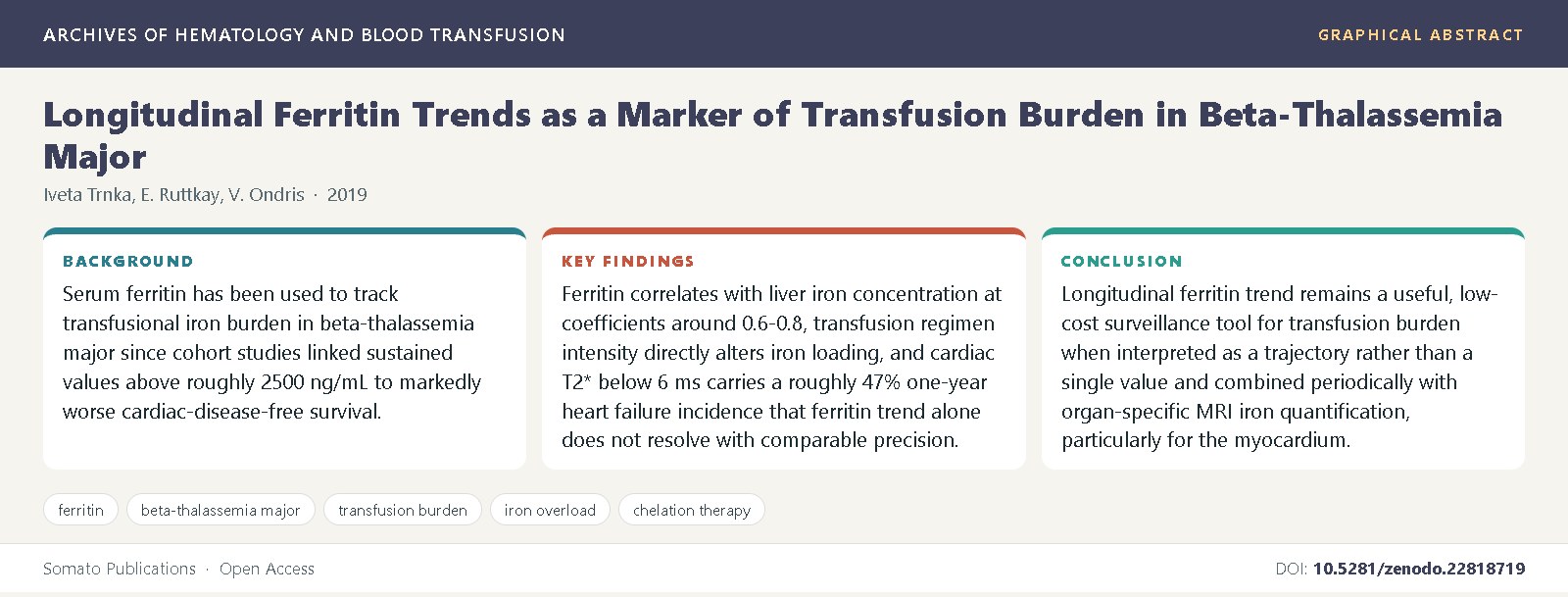
Background: Serum ferritin has been used to track transfusional iron burden in beta-thalassemia major since cohort studies linked sustained values above roughly 2500 ng/mL to markedly worse cardiac-disease-free survival [1,2].
Objective: This review synthesizes the published evidence on longitudinal ferritin trend as a marker of transfusion burden, its correlation with directly measured liver and cardiac iron, and its role alongside MRI-based monitoring and chelation response assessment.
Methods: We synthesized peer-reviewed cohort studies, randomized chelation trials, and MRI validation studies addressing ferritin, transfusion volume, liver iron concentration, and cardiac T2* in transfusion-dependent thalassemia major.
Findings: Ferritin correlates with liver iron concentration at coefficients around 0.6-0.8 [4], transfusion regimen intensity directly alters iron loading [3], and cardiac T2* below 6 ms carries a roughly 47% one-year heart failure incidence that ferritin trend alone does not resolve with comparable precision [13]; chelation trials show dose-dependent ferritin and liver iron reductions with deferasirox and combination regimens [17,19].
Conclusions: Longitudinal ferritin trend remains a useful, low-cost surveillance tool for transfusion burden when interpreted as a trajectory rather than a single value and combined periodically with organ-specific MRI iron quantification, particularly for the myocardium, where ferritin's predictive value is weakest [16,5].
References
Olivieri, N.F., Nathan, D.G., MacMillan, J.H., Wayne, A.S., Liu, P.P., McGee, A., et al. (1994) Survival in medically treated patients with homozygous beta-thalassemia. New England Journal of Medicine, 331(9): 574-578. DOI: 10.1056/NEJM199409013310903
Brittenham, G.M., Griffith, P.M., Nienhuis, A.W., McLaren, C.E., Young, N.S., Tucker, E.E., et al. (1994) Efficacy of deferoxamine in preventing complications of iron overload in patients with thalassemia major. New England Journal of Medicine, 331(9): 567-573. DOI: 10.1056/NEJM199409013310902
Cazzola, M., Borgna-Pignatti, C., Locatelli, F., Ponchio, L., Beguin, Y., De Stefano, P. (1997) A moderate transfusion regimen may reduce iron loading in beta-thalassemia major without producing excessive expansion of erythropoiesis. Transfusion, 37(2): 135-140. DOI: 10.1046/j.1537-2995.1997.37297203514.x
Wood, J.C., Enriquez, C., Ghugre, N., Tyzka, J.M., Carson, S., Nelson, M.D., et al. (2005) MRI R2 and R2* mapping accurately estimates hepatic iron concentration in transfusion-dependent thalassemia and sickle cell disease patients. Blood, 106(4): 1460-1465. DOI: 10.1182/blood-2004-10-3982
Angelucci, E., Barosi, G., Camaschella, C., Cappellini, M.D., Cazzola, M., Galanello, R., et al. (2008) Italian Society of Hematology practice guidelines for the management of iron overload in thalassemia major and related disorders. Haematologica, 93(5): 741-752. DOI: 10.3324/haematol.12413
Galanello, R., Origa, R. (2010) Beta-thalassemia. Orphanet Journal of Rare Diseases, 5: 11. DOI: 10.1186/1750-1172-5-11
Rund, D., Rachmilewitz, E. (2005) Beta-thalassemia. New England Journal of Medicine, 353(11): 1135-1146. DOI: 10.1056/NEJMra050436
Telfer, P., Coen, P.G., Christou, S., Hadjigavriel, M., Kolnakou, A., Pangalou, E., et al. (2006) Survival of medically treated thalassemia patients in Cyprus: trends and risk factors over the period 1980-2004. Haematologica, 91(9): 1187-1192.
Vichinsky, E., Neufeld, E., Trimble, S., Levine, R., Lulla, R., Salata, J., et al. (2005) Comparison of organ dysfunction in transfused patients with sickle cell disease or beta thalassemia. American Journal of Hematology, 80(1): 70-74. DOI: 10.1002/ajh.20402
Neufeld, E.J. (2006) Oral chelators deferasirox and deferiprone for transfusional iron overload in thalassemia major: new data, new questions. Blood, 107(9): 3436-3441.
St Pierre, T.G., Clark, P.R., Chua-anusorn, W., Fleming, A.J., Jeffrey, G.P., Olynyk, J.K., et al. (2005) Noninvasive measurement and imaging of liver iron concentrations using proton magnetic resonance. Blood, 105(2): 855-861. DOI: 10.1182/blood-2004-01-0177
Anderson, L.J., Holden, S., Davis, B., Prescott, E., Charrier, C.C., Bunce, N.H., et al. (2001) Cardiovascular T2-star (T2*) magnetic resonance for the early diagnosis of myocardial iron overload. European Heart Journal, 22(23): 2171-2179. DOI: 10.1053/euhj.2001.2822
Kirk, P., Roughton, M., Porter, J.B., Walker, J.M., Tanner, M.A., Patel, J., et al. (2009) Cardiac T2* magnetic resonance for prediction of cardiac complications in thalassemia major. Circulation, 120(20): 1961-1968. DOI: 10.1161/CIRCULATIONAHA.109.874487
Wood, J.C., Tyszka, J.M., Carson, S., Nelson, M.D., Coates, T.D. (2004) Myocardial iron loading in transfusion-dependent thalassemia and sickle cell disease. Blood, 103(5): 1934-1936. DOI: 10.1182/blood-2003-06-1919
Davis, B.A., O'Sullivan, C., Jarritt, P.H., Porter, J.B. (2004) Value of sequential monitoring of left ventricular ejection fraction in the management of thalassemia major. Blood, 104(1): 263-269. DOI: 10.1182/blood-2003-08-2841
Porter, J.B., Cappellini, M.D., Kattamis, A., Viprakasit, V., Musallam, K.M., Zhu, Z., et al. (2013) Iron overload across the spectrum of non-transfusion-dependent thalassaemias: role of erythropoiesis, splenectomy and transfusion. British Journal of Haematology, 161(4): 587-594.
Cappellini, M.D., Cohen, A., Piga, A., Bejaoui, M., Perrotta, S., Agaoglu, L., et al. (2006) A phase 3 study of deferasirox (ICL670), a once-daily oral iron chelator, in patients with beta-thalassemia. Blood, 107(9): 3455-3462. DOI: 10.1182/blood-2005-08-3430
Piga, A., Galanello, R., Forni, G.L., Cappellini, M.D., Origa, R., Zappu, A., et al. (2006) Randomized phase II trial of deferasirox (Exjade, ICL670), a once-daily, orally-administered iron chelator, in comparison to deferoxamine in thalassemia patients with transfusional iron overload. Haematologica, 91(7): 873-880.
Pennell, D.J., Berdoukas, V., Karagiorga, M., Ladis, V., Piga, A., Aessopos, A., et al. (2006) Randomized controlled trial of deferiprone or deferoxamine in beta-thalassemia major patients with asymptomatic myocardial siderosis. Blood, 107(9): 3738-3744. DOI: 10.1182/blood-2005-07-2948
Kwiatkowski, J.L. (2012) Real-world use of iron chelators. Hematology American Society of Hematology Education Program, 2011(1): 451-458. DOI: 10.1182/asheducation-2011.1.451
Aydinok, Y., Porter, J.B., Piga, A., Elalfy, M., El-Beshlawy, A., Kilinc, Y., et al. (2015) Prevalence and distribution of iron overload in patients with transfusion-dependent anemias differs across geographic regions: results from the CORDELIA study. European Journal of Haematology, 95(3): 244-253. DOI: 10.1111/ejh.12487
Borgna-Pignatti, C., Rugolotto, S., De Stefano, P., Zhao, H., Cappellini, M.D., Del Vecchio, G.C., et al. (2004) Survival and complications in patients with thalassemia major treated with transfusion and deferoxamine. Haematologica, 89(10): 1187-1193.
Modell, B., Khan, M., Darlison, M. (2000) Survival in beta-thalassaemia major in the UK: data from the UK Thalassaemia Register. Lancet, 355(9220): 2051-2052. DOI: 10.1016/S0140-6736(00)02357-6
Gabutti, V., Piga, A. (1996) Results of long-term iron-chelating therapy. Acta Haematologica, 95(1): 26-36. DOI: 10.1159/000203853
Taher, A., El Rassi, F., Isma'eel, H., Koussa, S., Inati, A., Cappellini, M.D. (2008) Correlation of liver iron concentration determined by R2 magnetic resonance imaging with serum ferritin in patients with thalassemia intermedia. Haematologica, 93(10): 1584-1586. DOI: 10.3324/haematol.13098

Published
Issue
Section
License
Copyright (c) 2019 Iveta Trnka, et al.

This work is licensed under a Creative Commons Attribution 4.0 International License.


