
Impact of Universal Leukoreduction on Febrile Reaction Rates in a Regional Blood Service
DOI:
https://doi.org/10.5281/zenodo.22818731Keywords:
leukoreduction, febrile non-hemolytic transfusion reaction, blood transfusion safety, hemovigilance, platelet storageAbstract
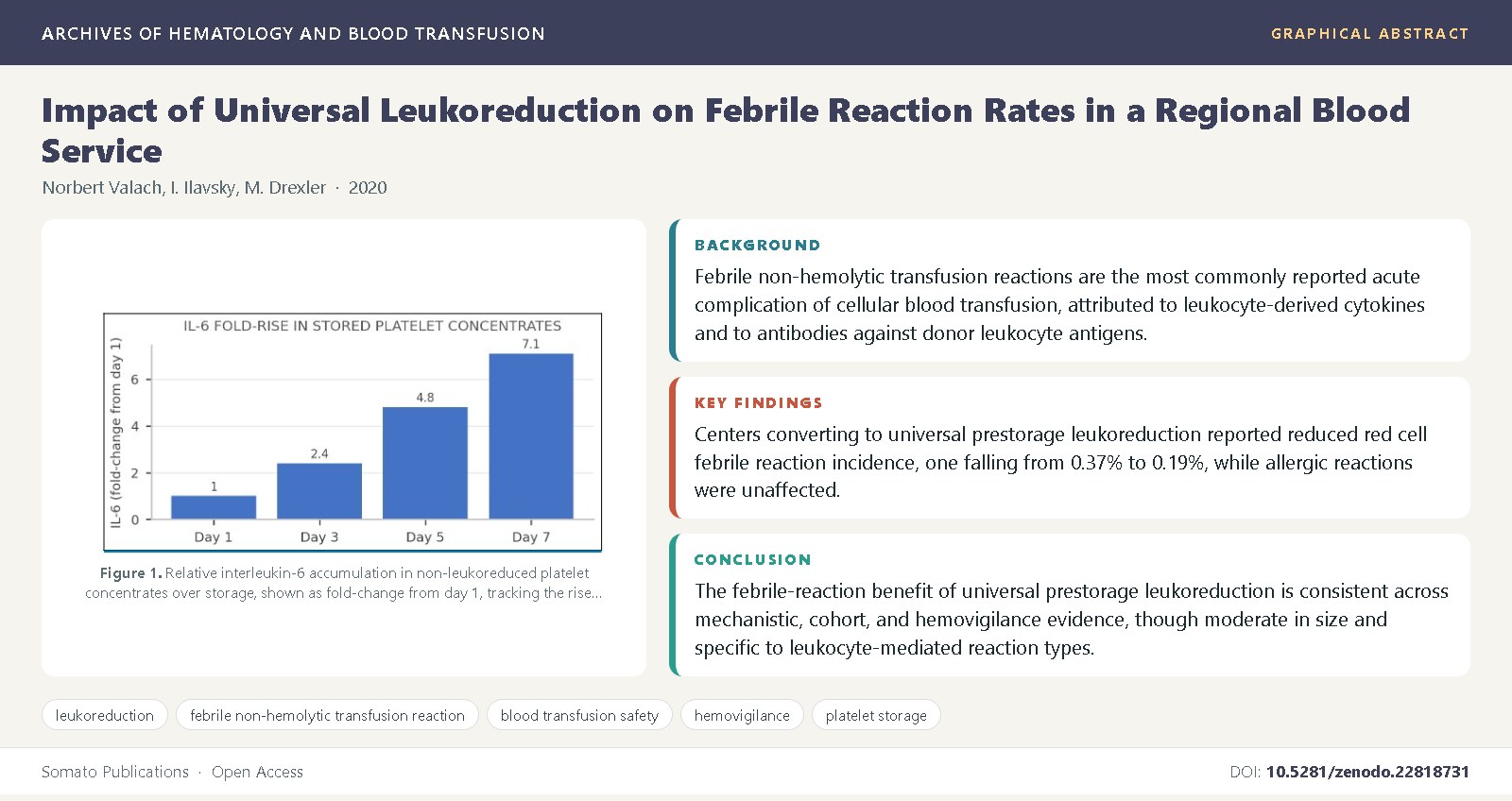
Background: Febrile non-hemolytic transfusion reactions are the most commonly reported acute complication of cellular blood transfusion, attributed to leukocyte-derived cytokines and to antibodies against donor leukocyte antigens.
Objective: To synthesize the literature on the mechanism of febrile reactions and the effect of universal leukoreduction on reaction rates in blood services converting from selective to universal prestorage filtration.
Methods: Narrative review of cytokine studies, single-center cohort studies from the early-2000s implementation era, randomized trials, and national hemovigilance reporting.
Findings: Centers converting to universal prestorage leukoreduction reported reduced red cell febrile reaction incidence, one falling from 0.37% to 0.19%, while allergic reactions were unaffected; prestorage filtration prevents cytokine accumulation that bedside filtration cannot reverse, and residual risk concentrates in platelets and multiply-transfused recipients.
Conclusions: The febrile-reaction benefit of universal prestorage leukoreduction is consistent across mechanistic, cohort, and hemovigilance evidence, though moderate in size and specific to leukocyte-mediated reaction types.
References
Bordin, J.O., Heddle, N.M., Blajchman, M.A. (1994) Biologic effects of leukocytes present in transfused cellular blood products. Blood, 84(6): 1703-1721. DOI: 10.1182/blood.V84.6.1703.1703
Muylle, L., Wouters, E., Peetermans, M.E. (1993) Increased tumor necrosis factor alpha (TNFalpha), interleukin 1, and interleukin 6 (IL-6) levels in the plasma of stored platelet concentrates: relationship between TNFalpha and IL-6 levels and febrile transfusion reactions. Vox Sanguinis, 64(1): 16-19. DOI: 10.1046/j.1537-2995.1993.33393174443.x
Stack, G., Snyder, E.L. (1994) Cytokine generation in stored platelet concentrates. Transfusion, 34(1): 20-25. DOI: 10.1046/j.1537-2995.1994.34194098597.x
Kluter, H., Bubel, S., Kirchner, H., Wilhelm, D. (1995) Cytokines in platelet concentrates prepared from pooled buffy coats. Vox Sanguinis, 68(4): 211-217. DOI: 10.1111/j.1423-0410.1995.tb00345.x
Grey, S.J., Tan, S.M., Contreras, M. (1998) Monocyte activation in platelet concentrates. Vox Sanguinis, 75(2): 261-265. DOI: 10.1046/j.1423-0410.1998.7520110.x
Ferrara, J.L., Deeg, H.J., Snyder, E.L. (1995) The febrile platelet transfusion reaction: a cytokine shower. Transfusion, 35(2): 89-97. DOI: 10.1046/j.1537-2995.1995.35295125744.x
Sacher, R.A., Luban, N.L., Strauss, R.G. (1993) High circulating interleukin 6 levels associated with acute transfusion reaction: cause or effect? Transfusion, 33(11): 891-894. DOI: 10.1046/j.1537-2995.1993.331194082392.x
King, K.E., Shirey, R.S., Thoman, S.K., Bensen-Kennedy, D., Tanz, W.S., Ness, P.M. (2004) Universal leukoreduction decreases the incidence of febrile nonhemolytic transfusion reactions to RBCs. Transfusion, 44(1): 25-29. DOI: 10.1046/j.0041-1132.2004.00609.x
Paglino, J.C., Pomper, G.J., Fisch, G.S., Champion, M.H., Snyder, E.L. (2004) Reduction of febrile but not allergic reactions to RBCs and platelets after conversion to universal prestorage leukoreduction. Transfusion, 44(1): 16-24. DOI:
1046/j.0041-1132.2004.00608.x 10. Yazer, M.H., Podlosky, L., Clarke, G., Nahirniak, S.M. (2004) The effect of prestorage WBC reduction on the rates of febrile nonhemolytic transfusion reactions to platelet concentrates and RBC. Transfusion, 44(1): 10-15. DOI: 10.1046/j.0041-1132.2003.00518.x
Heddle, N.M. (2004) Universal leukoreduction and acute transfusion reactions: putting the puzzle together. Transfusion, 44(1): 1-3. DOI: 10.1111/j.0041-1132.2004.00657.x
Uhlmann, E.J., Isgriggs, E., Wallhermfechtel, M., Goodnough, L.T. (2001) Prestorage universal WBC reduction of RBC units does not affect the incidence of transfusion reactions. Transfusion, 41(8): 997-1000. DOI: 10.1046/j.1537-2995.2001.41080997.x
Heddle, N.M., Klama, L., Meyer, R., Walker, I., Boshkov, L., Roberts, R., Chambers, S., Podlosky, L., O'Hoski, P., Levine, M. (1999) A randomized controlled trial comparing plasma removal with white cell reduction to prevent reactions to platelets. Transfusion, 39(3): 231-238. DOI: 10.1046/j.1537-2995.1999.39399219278.x
Heddle, N.M., Klama, L., Singer, J., Richards, C., Fedak, P., Walker, I., Kelton, J.G. (1994) The role of the plasma from platelet concentrates in transfusion reactions. New England Journal of Medicine, 331(10): 625-628. DOI: 10.1056/NEJM199409083311001
van de Watering, L.M., Hermans, J., Houbiers, J.G., van den Broek, P.J., Bouter, H., Boer, F., Harvey, M.S., Huysmans, H.A., Brand, A. (1998) Beneficial effects of leukocyte depletion of transfused blood on postoperative complications in patients undergoing cardiac surgery: a randomized clinical trial. Circulation, 97(6): 562-568. DOI: 10.1161/01.CIR.97.6.562
Bilgin, Y.M., van de Watering, L.M., Eijsman, L., Versteegh, M.I., Brand, R., van Oers, M.H., Brand, A. (2004) Double-blind, randomized controlled trial on the effect of leukocyte-depleted erythrocyte transfusions in cardiac valve surgery. Circulation, 109(22): 2755-2760. DOI: 10.1161/01.CIR.0000130162.11925.21
AuBuchon, J.P., Pickard, C., Herschel, L., Roger, J. (1997) Evaluation of a new prestorage leukoreduction filter for red blood cell units. Vox Sanguinis, 72(2): 96-102. DOI: 10.1046/j.1423-0410.1997.7220101.x
Sarkodee-Adoo, C.B., Kendall, J.M., Sridhara, R., Lee, E.J., Schiffer, C.A. (1998) The relationship between the duration of platelet storage and the development of transfusion reactions. Transfusion, 38(1): 24-30. DOI: 10.1046/j.1537-2995.1998.38398222865.x
Tasaki, T., Ohto, H., Noguchi, M., Furuya, K. (2009) Significance of pre-storage leucoreduction for autologous blood. Vox Sanguinis, 97(2): 135-140. DOI: 10.1111/j.1423-0410.2008.01139.x
Sharma, R.R., Marwaha, N. (2010) Leukoreduced blood components: advantages and strategies for its implementation in developing countries. Asian Journal of Transfusion Science, 4(1): 3-8. DOI: 10.4103/0973-6247.59384
Blajchman, M.A. (2006) The clinical benefits of the leukoreduction of blood products. Journal of Trauma, 60(6 Suppl): S83-S90. DOI: 10.1097/01.ta.0000199537.09201.7b
Kato, H., Uruma, M., Sakamoto, S., Kumagai, S., Sato, S. (2015) A retrospective observational study to assess adverse transfusion reactions of patients with and without prior transfusion history. Vox Sanguinis, 109(2): 122-128. DOI: 10.1111/vox.12208
Vamvakas, E.C., Blajchman, M.A. (2001) Deleterious clinical effects of transfusion-associated immunomodulation: fact or fiction? Blood, 97(5): 1180-1195. DOI: 10.1182/blood.V97.5.1180
Vamvakas, E.C. (2007) White-blood-cell-containing allogeneic blood transfusion and postoperative infection or mortality: an updated meta-analysis. Vox Sanguinis, 92(3): 224-232. DOI: 10.1111/j.1423-0410.2006.00889.x
Bolton-Maggs, P.H.B., Cohen, H. (2013) Serious hazards of transfusion - a decade of hemovigilance reports. British Journal of Haematology, 163(3): 303-314. DOI: 10.1111/bjh.12547

Published
Issue
Section
License
Copyright (c) 2020 Norbert Valach, et al.

This work is licensed under a Creative Commons Attribution 4.0 International License.


