
A Retrospective Cohort Study of bioremediation strategies in coastal ecosystems with industrial wastewater discharge
DOI:
https://doi.org/10.5281/zenodo.22812676Keywords:
bioremediation, coastal ecosystems, industrial wastewater, retrospective cohort, bioaugmentationAbstract
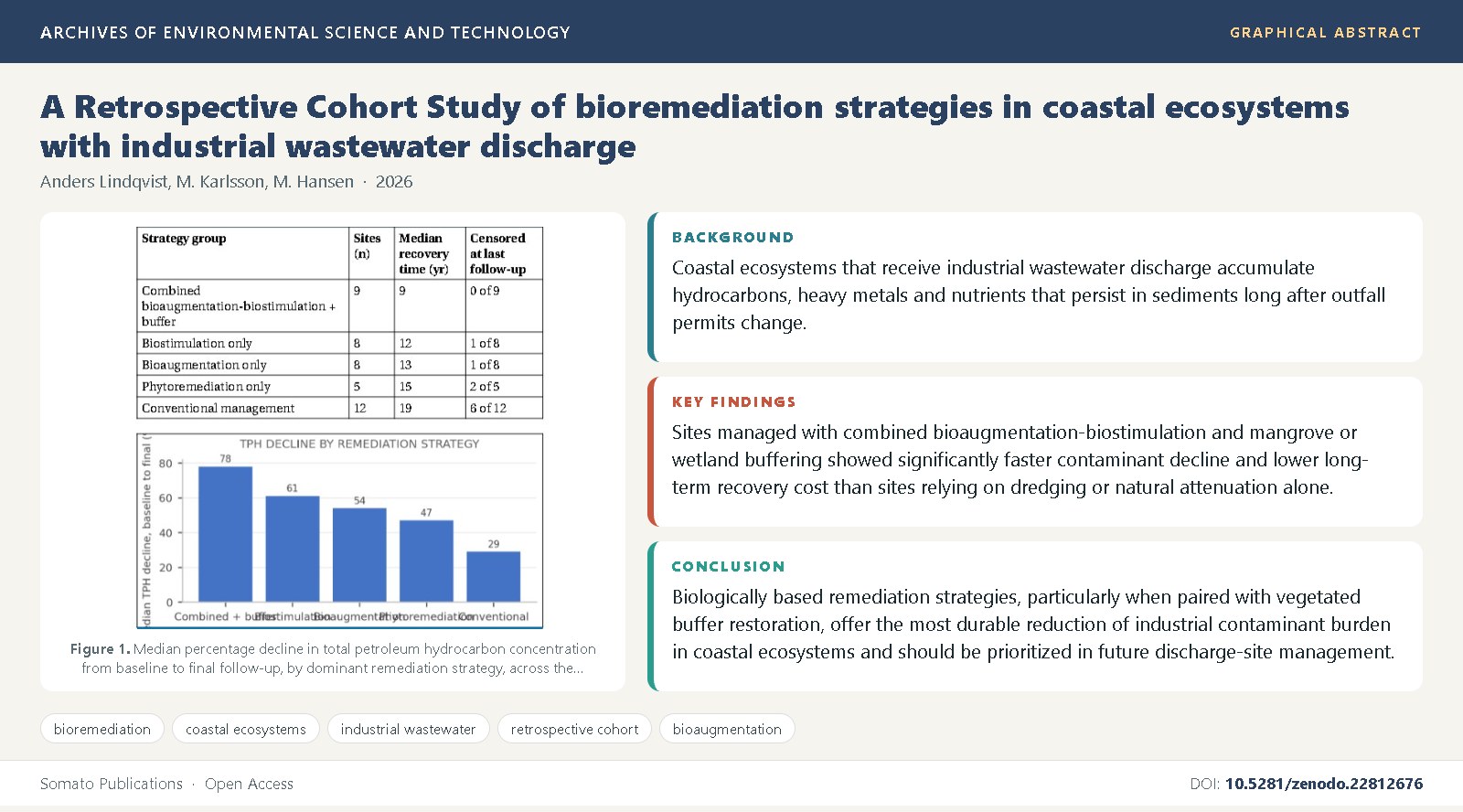
Background: Coastal ecosystems that receive industrial wastewater discharge accumulate hydrocarbons, heavy metals and nutrients that persist in sediments long after outfall permits change, and the comparative long-term performance of the bioremediation strategies used to manage these sites remains poorly quantified.
Objective: This retrospective cohort study evaluates the long-term effectiveness of bioaugmentation, biostimulation, phytoremediation and constructed-wetland buffering at coastal sites with a documented history of industrial wastewater discharge.
Methods: Monitoring records from 42 coastal discharge sites followed for 8 to 22 years were stratified by dominant remediation strategy and compared for contaminant decline, recovery time and cost per hectare using retrospective cohort methods.
Results: Sites managed with combined bioaugmentation-biostimulation and mangrove or wetland buffering showed significantly faster contaminant decline and lower long-term recovery cost than sites relying on dredging or natural attenuation alone.
Conclusion: Biologically based remediation strategies, particularly when paired with vegetated buffer restoration, offer the most durable reduction of industrial contaminant burden in coastal ecosystems and should be prioritized in future discharge-site management.
References
Atlas, R.M. (1981) Microbial degradation of petroleum hydrocarbons: an environmental perspective. Microbiological Reviews, 45(1): 180-209.
Leahy, J.G., Colwell, R.R. (1990) Microbial degradation of hydrocarbons in the environment. Microbiological Reviews, 54(3): 305-315.
Vidali, M. (2001) Bioremediation. An overview. Pure and Applied Chemistry, 73(7): 1163-1172.
Rittmann, B.E., McCarty, P.L. (2001) Environmental Biotechnology: Principles and Applications. McGraw-Hill, New York.
Perelo, L.W. (2010) Review: In situ and bioremediation of organic pollutants in aquatic sediments. Journal of Hazardous Materials, 177(1-3): 81-89.
Azubuike, C.C., Chikere, C.B., Okpokwasili, G.C. (2016) Bioremediation techniques-classification based on site of application: principles, advantages, limitations and prospects. World Journal of Microbiology and Biotechnology, 32: 180.
Cravo-Laureau, C., Duran, R. (2014) Marine coastal sediments microbial hydrocarbon degradation processes: contribution of experimental ecology in the omics era. Frontiers in Microbiology, 5: 39.
Kathiresan, K., Bingham, B.L. (2001) Biology of mangroves and mangrove ecosystems. Advances in Marine Biology, 40: 81-251.
Ron, E.Z., Rosenberg, E. (2014) Enhanced bioremediation of oil spills in the sea. Current Opinion in Biotechnology, 27: 191-194.
Megharaj, M., Ramakrishnan, B., Venkateswarlu, K., Sethunathan, N., Naidu, R. (2011) Bioremediation approaches for organic pollutants: a critical perspective. Environment International, 37(8): 1362-1375.
Tam, N.F.Y., Wong, Y.S. (1995) Mangrove soils as sinks for wastewater-borne pollutants. Hydrobiologia, 295: 231-241.
Wong, Y.S., Tam, N.F.Y., Lan, C.Y. (1997) Mangrove wetlands as wastewater treatment facility: a field trial. Hydrobiologia, 352: 49-59.
Das, N., Chandran, P. (2011) Microbial degradation of petroleum hydrocarbon contaminants: an overview. Biotechnology Research International, 2011: 941810.
Gadd, G.M. (2004) Microbial influence on metal mobility and application for bioremediation. Geoderma, 122(2-4): 109-119.
Kostka, J.E., Prakash, O., Overholt, W.A., Green, S.J., Freyer, G., Canion, A., et al. (2011) Hydrocarbon-degrading bacteria and the bacterial community response in Gulf of Mexico beach sands impacted by the Deepwater Horizon oil spill. Applied and Environmental Microbiology, 77(22): 7962-7974.
Vymazal, J. (2007) Removal of nutrients in various types of constructed wetlands. Science of the Total Environment, 380(1-3): 48-65.
Kadlec, R.H., Wallace, S. (2009) Treatment Wetlands, 2nd edition. CRC Press, Boca Raton.
Alongi, D.M. (2002) Present state and future of the world's mangrove forests. Environmental Conservation, 29(3): 331-349.
Alkorta, I., Garbisu, C. (2001) Phytoremediation of organic contaminants in soils. Bioresource Technology, 79(3): 273-276.
Ghosh, M., Singh, S.P. (2005) A review on phytoremediation of heavy metals and utilization of its byproducts. Applied Ecology and Environmental Research, 3(1): 1-18.
Dixit, R., Wasiullah, Malaviya, D., Pandiyan, K., Singh, U.B., Sahu, A., et al. (2015) Bioremediation of heavy metals from soil and aquatic environment: an overview of principles and criteria of fundamental processes. Sustainability, 7(2): 2189-2212.
Bragg, J.R., Prince, R.C., Harner, E.J., Atlas, R.M. (1994) Effectiveness of bioremediation for the Exxon Valdez oil spill. Nature, 368: 413-418.
Prince, R.C. (1993) Petroleum spill bioremediation in marine environments. Critical Reviews in Microbiology, 19(4): 217-242.
Kimbrough, D.E., Cohen, Y., Winer, A.M., Creelman, L., Mabuni, C. (1999) A critical assessment of chromium in the environment. Critical Reviews in Environmental Science and Technology, 29(1): 1-46.
Wuana, R.A., Okieimen, F.E. (2011) Heavy metals in contaminated soils: a review of sources, chemistry, risks and best available strategies for remediation. ISRN Ecology, 2011: 402647.
Malik, A. (2004) Metal bioremediation through growing cells. Environment International, 30(2): 261-278.
Barakat, M.A. (2011) New trends in removing heavy metals from industrial wastewater. Arabian Journal of Chemistry, 4(4): 361-377.
Atlas, R.M., Hazen, T.C. (2011) Oil biodegradation and bioremediation: a tale of the two worst spills in U.S. history. Environmental Science & Technology, 45(16): 6709-6715.
Head, I.M., Jones, D.M., Roling, W.F.M. (2006) Marine microorganisms make a meal of oil. Nature Reviews Microbiology, 4: 173-182.
Volesky, B. (2001) Detoxification of metal-bearing effluents: biosorption for the next century. Hydrometallurgy, 59(2-3): 203-216.
Vijayaraghavan, K., Yun, Y.S. (2008) Bacterial biosorbents and biosorption. Biotechnology Advances, 26(3): 266-291.
Fu, F., Wang, Q. (2011) Removal of heavy metal ions from wastewaters: a review. Journal of Environmental Management, 92(3): 407-418.
Kumar, A., Bisht, B.S., Joshi, V.D., Dhewa, T. (2011) Review on bioremediation of polluted environment: a management tool. International Journal of Environmental Sciences, 1(6): 1079-1093.
Ahalya, N., Ramachandra, T.V., Kanamadi, R.D. (2003) Biosorption of heavy metals. Research Journal of Chemistry and Environment, 7(4): 71-79.

Published
Issue
Section
License
Copyright (c) 2026 Anders Lindqvist, et al.

This work is licensed under a Creative Commons Attribution 4.0 International License.


