
Comparative Analysis of constructed wetland treatment versus Standard Care in microplastic pollution
DOI:
https://doi.org/10.5281/zenodo.22812711Keywords:
microplastic pollution, constructed wetland, wastewater treatment, removal efficiency, biosolidsAbstract
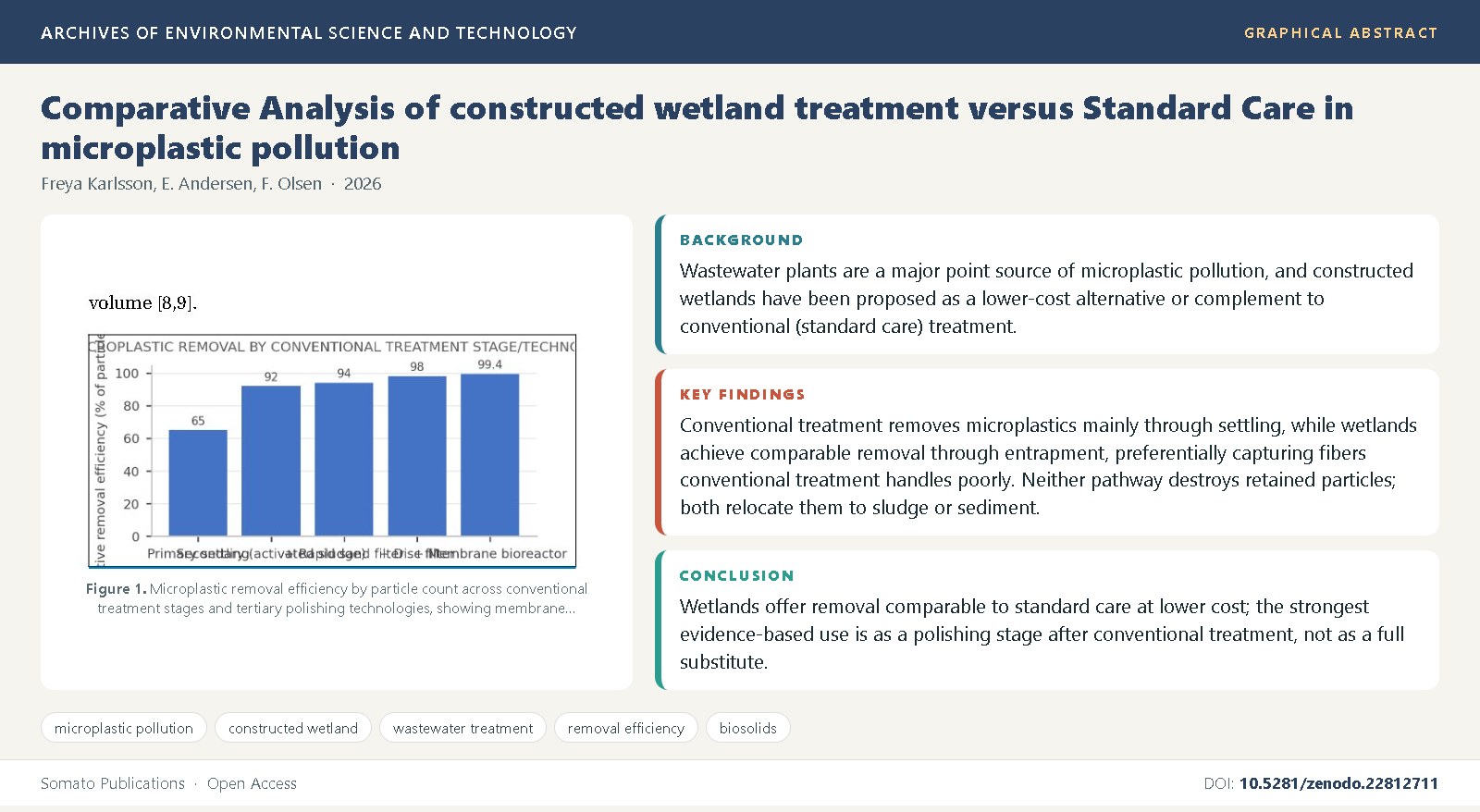
Background: Wastewater plants are a major point source of microplastic pollution, and constructed wetlands have been proposed as a lower-cost alternative or complement to conventional (standard care) treatment.
Objective: This review compares removal efficiency, retention mechanisms, and size-dependent selectivity between constructed wetlands and conventional wastewater treatment for microplastic pollution.
Methods: We synthesized field and pilot-scale studies quantifying microplastic removal across conventional treatment trains and constructed wetlands or related substrate-based systems, plus downstream-fate studies.
Findings: Conventional treatment removes microplastics mainly through settling, while wetlands achieve comparable removal through entrapment, preferentially capturing fibers conventional treatment handles poorly. Neither pathway destroys retained particles; both relocate them to sludge or sediment.
Conclusions: Wetlands offer removal comparable to standard care at lower cost; the strongest evidence-based use is as a polishing stage after conventional treatment, not as a full substitute.
References
Murphy, F., Ewins, C., Carbonnier, F., Quinn, B. (2016) Wastewater treatment works (WwTW) as a source of microplastics in the aquatic environment. Environmental Science & Technology, 50(11): 5800-5808. DOI: 10.1021/acs.est.5b05416
Carr, S.A., Liu, J., Tesoro, A.G. (2016) Transport and fate of microplastic particles in wastewater treatment plants. Water Research, 91: 174-182. DOI: 10.1016/j.watres.2016.01.002
Rochman, C.M., Hoellein, T. (2020) The global odyssey of plastic pollution. Science, 368(6496): 1184-1185. DOI: 10.1126/science.abc4428
Prata, J.C. (2018) Microplastics in wastewater: state of the knowledge on sources, fate and solutions. Marine Pollution Bulletin, 129(1): 262-265. DOI: 10.1016/j.marpolbul.2018.02.046
Hurley, R.R., Nizzetto, L. (2018) Fate and occurrence of micro(nano)plastics in soils: knowledge gaps and possible risks. Current Opinion in Environmental Science & Health, 1: 6-11. DOI: 10.1016/j.coesh.2017.10.006
Eerkes-Medrano, D., Thompson, R.C., Aldridge, D.C. (2015) Microplastics in freshwater systems: a review of the emerging threats, identification of knowledge gaps and prioritisation of research needs. Water Research, 75: 63-82. DOI: 10.1016/j.watres.2015.02.012
Sun, J., Dai, X., Wang, Q., van Loosdrecht, M.C.M., Ni, B.J. (2019) Microplastics in wastewater treatment plants: detection, occurrence and removal. Water Research, 152: 21-37. DOI: 10.1016/j.watres.2018.12.050
Gies, E.A., LeNoble, J.L., Noel, M., Etemadifar, A., Bishay, F., Hall, E.R., Ross, P.S. (2018) Retention of microplastics in a major secondary wastewater treatment plant in Vancouver, Canada. Marine Pollution Bulletin, 133: 553-561. DOI: 10.1016/j.marpolbul.2018.06.006
Kay, P., Hiscoe, R., Moberley, I., Bajic, L., McKenna, N. (2018) Wastewater treatment plants as a source of microplastics in river catchments. Environmental Science and Pollution Research, 25: 20264-20267. DOI: 10.1007/s11356-018-2070-7
Talvitie, J., Mikola, A., Koistinen, A., Setala, O. (2017) Solutions to microplastic pollution: removal of microplastics from wastewater effluent with advanced wastewater treatment technologies. Water Research, 123: 401-407. DOI: 10.1016/j.watres.2017.07.005
Talvitie, J., Mikola, A., Setala, O., Heinonen, M., Koistinen, A. (2017) How well is microlitter purified from wastewater? A detailed study on the stepwise removal of microlitter in a tertiary level wastewater treatment plant. Water Research, 109: 164-172. DOI: 10.1016/j.watres.2016.11.046
Lares, M., Ncibi, M.C., Sillanpaa, M., Sillanpaa, M. (2018) Occurrence, identification and removal of microplastic particles and fibers in conventional activated sludge process and advanced MBR technology. Water Research, 133: 236-246. DOI: 10.1016/j.watres.2018.01.049
Bayo, J., Lopez-Castellanos, J., Olmos, S. (2020) Membrane bioreactor and rapid sand filtration for the removal of microplastics in an urban wastewater treatment plant. Marine Pollution Bulletin, 156: 111211. DOI: 10.1016/j.marpolbul.2020.111211
Long, Z., Pan, Z., Wang, W., Ren, J., Yu, X., Lin, L., Lin, H., Chen, H., Jin, X. (2019) Microplastic abundance, characteristics, and removal in wastewater treatment plants in a coastal city of China. Water Research, 155: 255-265. DOI: 10.1016/j.watres.2019.02.028
Simon, M., van Alst, N., Vollertsen, J. (2018) Quantification of microplastic mass and removal rates at wastewater treatment plants applying Focal Plane Array (FPA)-based Fourier Transform Infrared (FT-IR) imaging. Water Research, 142: 1-9. DOI: 10.1016/j.watres.2018.05.019
Michielssen, M.R., Michielssen, E.R., Ni, J., Duhaime, M.B. (2016) Fate of microplastics and other small anthropogenic litter (SAL) in wastewater treatment plants depends on unit processes employed. Environmental Science: Water Research & Technology, 2: 1064-1073. DOI: 10.1039/C6EW00207B
Conley, K., Clum, A., Deepe, J., Lane, H., Beckingham, B. (2019) Wastewater treatment plants as a source of microplastics to an urban estuary: removal efficiencies and loading per capita over one year. Water Research X, 3: 100030. DOI: 10.1016/j.wroa.2019.100030
Vollertsen, J., Hansen, A.A. (2017) Microplastic in Danish wastewater: sources, occurrences and fate. Danish Environmental Protection Agency, Environmental Project No. 1906.
Magnusson, K., Noren, F. (2014) Screening of microplastic particles in and down-stream a wastewater treatment plant. IVL Swedish Environmental Research Institute Report, C 55.
Liu, F., Vianello, A., Vollertsen, J. (2019) Retention of microplastics in sediments of urban and highway stormwater retention ponds. Environmental Pollution, 255: 113335. DOI: 10.1016/j.envpol.2019.113335
Smyth, K., Drake, J., Li, Y., Rochman, C., Van Seters, T., Passeport, E. (2021) Bioretention cells remove microplastics from urban stormwater. Water Research, 191: 116785. DOI: 10.1016/j.watres.2020.116785
Werbowski, L.M., Gilbreath, A.N., Munno, K., Zhu, X., Grbic, J., Wu, T., Sutton, R., Sedlak, M.D., Deshpande, A.D., Rochman, C.M. (2021) Urban stormwater runoff: a major pathway for retention and granular filtration of microplastics. ACS ES&T Water, 1(6): 1420-1428. DOI: 10.1021/acsestwater.1c00072
Wang, Z., Sedighi, M., Lea-Langton, A. (2020) Filtration of microplastic spheres by biochar: removal efficiency and immobilisation mechanisms. Water Research, 184: 116165. DOI: 10.1016/j.watres.2020.116165
Schwarz, A.E., Ligthart, T.N., Boukris, E., van Harmelen, T. (2019) Sources, transport, and accumulation of different types of plastic litter in aquatic environments: a review study. Marine Pollution Bulletin, 143: 92-100. DOI: 10.1016/j.marpolbul.2019.04.029
Kelly, J.J., London, M.G., McCormick, A.R., Rojas, M., Scott, J.W., Hoellein, T.J. (2021) Wastewater treatment alters microbial colonization of microplastics. PLOS ONE, 16(1): e0244443. DOI: 10.1371/journal.pone.0244443
Ziajahromi, S., Neale, P.A., Rintoul, L., Leusch, F.D.L. (2017) Wastewater treatment plants as a pathway for microplastics: development of a new approach to sample wastewater-based microplastics. Water Research, 112: 93-99. DOI: 10.1016/j.watres.2017.01.042
Mintenig, S.M., Int-Veen, I., Loder, M.G.J., Primpke, S., Gerdts, G. (2017) Identification of microplastic in effluents of waste water treatment plants using focal plane array-based micro-Fourier-transform infrared imaging. Water Research, 108: 365-372. DOI: 10.1016/j.watres.2016.11.015
Zubris, K.A.V., Richards, B.K. (2005) Synthetic fibers as an indicator of land application of sludge. Environmental Pollution, 138(2): 201-211. DOI: 10.1016/j.envpol.2005.04.013
Nizzetto, L., Bussi, G., Futter, M.N., Butterfield, D., Whitehead, P.G. (2016) A theoretical assessment of microplastic transport in river catchments and their retention by soils and river sediments. Environmental Science: Processes & Impacts, 18(8): 1050-1059. DOI: 10.1039/C6EM00206D
Nizzetto, L., Futter, M., Langaas, S. (2016) Are agricultural soils dumps for microplastics of urban origin? Environmental Science & Technology, 50(20): 10777-10779. DOI: 10.1021/acs.est.6b04140
Corradini, F., Meza, P., Eguiluz, R., Casado, F., Huerta-Lwanga, E., Geissen, V. (2019) Evidence of microplastic accumulation in agricultural soils from sewage sludge disposal. Science of the Total Environment, 671: 411-420. DOI: 10.1016/j.scitotenv.2019.03.368
Wright, S.L., Kelly, F.J. (2017) Plastic and human health: a micro issue? Environmental Science & Technology, 51(12): 6634-6647. DOI: 10.1021/acs.est.7b00423
Sun, Q., Ren, S.Y., Ni, H.G. (2020) Incidence of microplastics in personal care products: an appreciable part of plastic pollution. Science of the Total Environment, 742: 140218. DOI: 10.1016/j.scitotenv.2020.140218

Published
Issue
Section
License
Copyright (c) 2026 Freya Karlsson, et al.

This work is licensed under a Creative Commons Attribution 4.0 International License.


