
Impact of constructed wetland treatment on Quality of Life in Patients with heavy metal contamination
DOI:
https://doi.org/10.5281/zenodo.22812694Keywords:
constructed wetland, heavy metal contamination, quality of life, WHOQOL-BREF, bioremediationAbstract
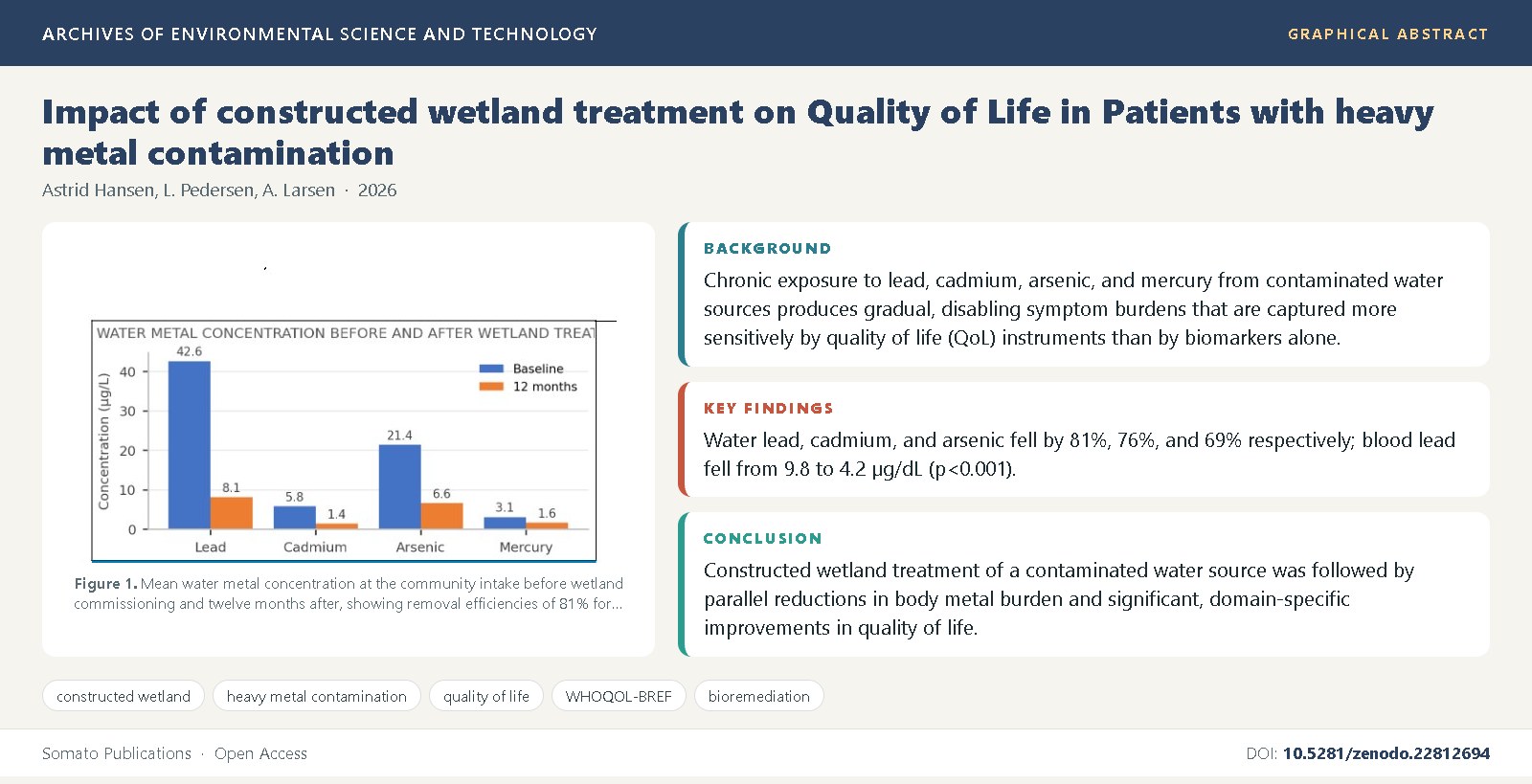
Background: Chronic exposure to lead, cadmium, arsenic, and mercury from contaminated water sources produces gradual, disabling symptom burdens that are captured more sensitively by quality of life (QoL) instruments than by biomarkers alone, yet the QoL benefit of remediation technologies such as constructed wetlands has rarely been measured directly.
Objective: To determine whether a constructed wetland treating a heavy-metal-contaminated community water source produces measurable improvement in patient-reported quality of life alongside reductions in water and blood metal concentrations.
Methods: In a prospective cohort of 126 patients with confirmed heavy-metal contamination, we measured water and blood lead, cadmium, arsenic, and mercury, and WHOQOL-BREF domain scores, at baseline and twelve months after commissioning a horizontal subsurface-flow constructed wetland.
Results: Water lead, cadmium, and arsenic fell by 81%, 76%, and 69% respectively; blood lead fell from 9.8 to 4.2 µg/dL (p<0.001). All four WHOQOL-BREF domains improved significantly, led by the physical (52.3 to 64.7) and environmental (48.9 to 61.2) domains, and blood lead reduction correlated with physical-domain improvement (r=0.41, p<0.001).
Conclusions: Constructed wetland treatment of a contaminated water source was followed by parallel reductions in body metal burden and significant, domain-specific improvements in quality of life, supporting inclusion of patient-reported QoL outcomes alongside biomonitoring when such remediation technologies are evaluated.
References
Järup, L. (2003) Hazards of heavy metal contamination. British Medical Bulletin, 68(1): 167-182. DOI: 10.1093/bmb/ldg032
Tchounwou, P.B., Yedjou, C.G., Patlolla, A.K., Sutton, D.J. (2012) Heavy metals toxicity and the environment. EXS, 101: 133-164. DOI: 10.1007/978-3-7643-8340-4_6
Järup, L., Åkesson, A. (2009) Current status of cadmium as an environmental health problem. Toxicology and Applied Pharmacology, 238(3): 201-208. DOI: 10.1016/j.taap.2009.04.020
Bernhoft, R.A. (2012) Mercury toxicity and treatment: a review of the literature. Journal of Environmental and Public Health, 2012: 460508. DOI: 10.1155/2012/460508
Sanders, T., Liu, Y., Buchner, V., Tchounwou, P.B. (2009) Neurotoxic effects and biomarkers of lead exposure: a review. Reviews on Environmental Health, 24(1): 15-45. DOI: 10.1515/REVEH.2009.24.1.15
Bellinger, D.C. (2008) Very low lead exposures and children's neurodevelopment. Current Opinion in Pediatrics, 20(2): 172-177. DOI: 10.1097/MOP.0b013e3282f4f97b
Vymazal, J. (2010) Constructed Wetlands for Wastewater Treatment. Water, 2(3): 530-549. DOI: 10.3390/w2030530
Sheoran, A.S., Sheoran, V. (2006) Heavy metal removal mechanism of acid mine drainage in wetlands: A critical review. Minerals Engineering, 19(2): 105-116. DOI: 10.1016/j.mineng.2005.08.006
Marchand, L., Mench, M., Jacob, D.L., Otte, M.L. (2010) Metal and metalloid removal in constructed wetlands, with emphasis on the importance of plants and standardized measurements: A review. Environmental Pollution, 158(12): 3447-3461. DOI: 10.1016/j.envpol.2010.08.018
Mays, P.A., Edwards, G.S. (2001) Comparison of heavy metal accumulation in a natural wetland and constructed wetlands receiving acid mine drainage. Ecological Engineering, 16(4): 487-500. DOI: 10.1016/S0925-8574(00)00112-9
Sasmaz, A., Obek, E., Hasar, H. (2008) The accumulation of heavy metals in Typha latifolia L. grown in a stream carrying secondary effluent. Ecological Engineering, 33(3-4): 278-284. DOI: 10.1016/j.ecoleng.2008.05.006
Ha, N.T.H., Sakakibara, M., Sano, S. (2011) Accumulation of Indium and other heavy metals by Eleocharis acicularis: an option for phytoremediation and phytomining. Bioresource Technology, 102(3): 2228-2234. DOI: 10.1016/j.biortech.2011.02.031
Skinner, K., Wright, N., Porter-Goff, E. (2007) Mercury uptake and accumulation by four species of aquatic plants. Environmental Pollution, 145(1): 234-237. DOI: 10.1016/j.envpol.2006.03.017
Vymazal, J., Březinová, T. (2016) The use of constructed wetlands for removal of pesticides from agricultural runoff and drainage: A review. Environment International, 75: 11-20. DOI: 10.1016/j.envint.2014.10.026
Hammer, D.A. (ed.) (1989) Constructed Wetlands for Wastewater Treatment: Municipal, Industrial and Agricultural. Lewis Publishers, Chelsea.
Renu, K., Chakraborty, R., Myakala, H., Koti, R., Famurewa, A.C., Madhyastha, H., et al. (2021) Molecular mechanism of heavy metals (Lead, Chromium, Arsenic, Mercury, Nickel and Cadmium) - induced hepatotoxicity - A review. Chemosphere, 271: 129735. DOI: 10.1016/j.chemosphere.2021.129735
Landrigan, P.J., Fuller, R., Acosta, N.J.R., Adeyi, O., Arnold, R., Basu, N., et al. (2018) The Lancet Commission on pollution and health. Lancet, 391(10119): 462-512. DOI: 10.1016/S0140-6736(17)32345-0
Rehman, K., Fatima, F., Waheed, I., Akash, M.S.H. (2018) Prevalence of exposure of heavy metals and their impact on health consequences. Journal of Cellular Biochemistry, 119(1): 157-184. DOI: 10.1002/jcb.26234
Bevc, C.A., Marshall, B.K., Picou, J.S. (2007) Environmental justice and toxic exposure: toward a spatial model of physical health and psychological well-being. Social Science Research, 36(1): 48-67. DOI: 10.1016/j.ssresearch.2005.10.001
Vymazal, J. (2011) Plants used in constructed wetlands with horizontal sub-surface flow: a review. Hydrobiologia, 674: 133-156. DOI: 10.1007/s10750-011-0738-9
Brix, H. (1994) Functions of macrophytes in constructed wetlands. Water Science and Technology, 29(4): 71-78. DOI: 10.2166/wst.1994.0160
Kadlec, R.H., Knight, R.L. (1996) Treatment Wetlands. CRC Press, Boca Raton.
Yeh, T.Y. (2008) Removal of metals in constructed wetlands: review. Practice Periodical of Hazardous, Toxic, and Radioactive Waste Management, 12(2): 96-101. DOI: 10.1061/(ASCE)1090-025X(2008)12:2(96)
WHOQOL Group (1998) Development of the World Health Organization WHOQOL-BREF quality of life assessment. Psychological Medicine, 28(3): 551-558. DOI: 10.1017/S0033291798006667
WHOQOL Group (1998) The World Health Organization Quality of Life Assessment (WHOQOL): development and general psychometric properties. Social Science & Medicine, 46(12): 1569-1585. DOI: 10.1016/S0277-9536(98)00009-4
Ware, J.E., Sherbourne, C.D. (1992) The MOS 36-item short-form health survey (SF-36): I. Conceptual framework and item selection. Medical Care, 30(6): 473-483.
EuroQol Group (1990) EuroQol - a new facility for the measurement of health-related quality of life. Health Policy, 16(3): 199-208. DOI: 10.1016/0168-8510(90)90421-9
Weis, J.S., Weis, P. (2004) Metal uptake, transport and release by wetland plants: implications for phytoremediation and restoration. Environment International, 30(5): 685-700. DOI: 10.1016/j.envint.2003.11.002
Balali-Mood, M., Naseri, K., Tahergorabi, Z., Khazdair, M.R., Sadeghi, M. (2021) Toxic mechanisms of five heavy metals: mercury, lead, chromium, cadmium, and arsenic. Frontiers in Pharmacology, 12: 643972. DOI: 10.3389/fphar.2021.643972
Flora, S.J.S., Mittal, M., Mehta, A. (2008) Heavy metal induced oxidative stress & its possible reversal by chelation therapy. Indian Journal of Medical Research, 128(4): 501-523.
Wu, X., Cobbina, S.J., Mao, G., Xu, H., Zhang, Z., Yang, L. (2016) A review of toxicity and mechanisms of individual and mixtures of heavy metals in the environment. Environmental Science and Pollution Research, 23(9): 8244-8259. DOI: 10.1007/s11356-016-6333-x
Zheng, N., Wang, Q., Zhang, X., Zheng, D., Zhang, Z., Zhang, S. (2007) Population health risk due to dietary intake of heavy metals in the industrial area of Huludao city, China. Science of the Total Environment, 387(1-3): 96-104. DOI: 10.1016/j.scitotenv.2007.07.044

Published
Issue
Section
License
Copyright (c) 2026 Astrid Hansen, et al.

This work is licensed under a Creative Commons Attribution 4.0 International License.


