
Clinical Outcomes of root canal retreatment in Patients with temporomandibular joint disorder
DOI:
https://doi.org/10.5281/zenodo.22811991Keywords:
temporomandibular disorder, root canal retreatment, orofacial pain, nonodontogenic toothache, TMDAbstract
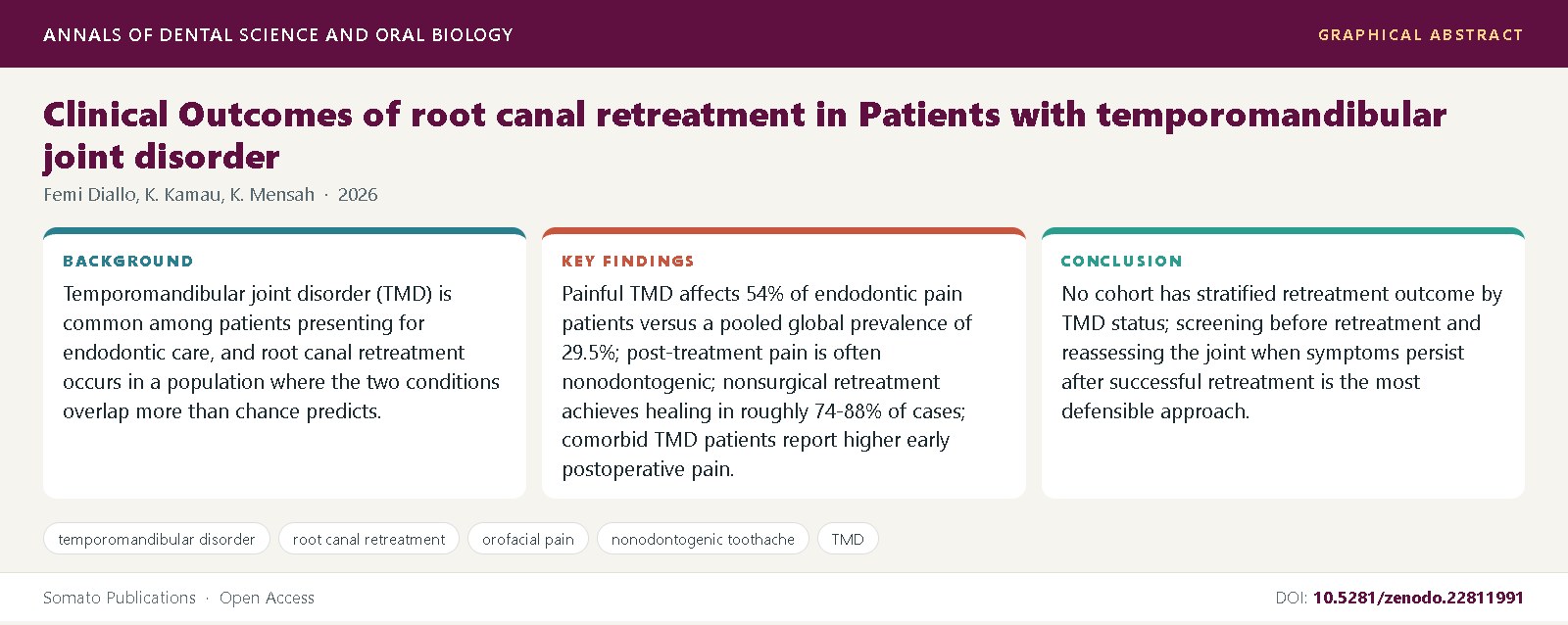
Background: Temporomandibular joint disorder (TMD) is common among patients presenting for endodontic care, and root canal retreatment occurs in a population where the two conditions overlap more than chance predicts.
Objective: This review synthesizes evidence on TMD prevalence among endodontic patients, mechanisms linking temporomandibular and dental pain, benchmark retreatment outcomes, and modifiers specific to comorbid TMD.
Methods: We synthesized systematic reviews of retreatment outcome, prospective and retrospective cohorts, epidemiological studies using validated DC/TMD criteria, and studies of referred orofacial pain and occlusal factors.
Findings: Painful TMD affects 54% of endodontic pain patients versus a pooled global prevalence of 29.5% [5,6]; post-treatment pain is often nonodontogenic [7]; nonsurgical retreatment achieves healing in roughly 74-88% of cases [15,11]; comorbid TMD patients report higher early postoperative pain [8].
Conclusions: No cohort has stratified retreatment outcome by TMD status; screening before retreatment and reassessing the joint when symptoms persist after successful retreatment is the most defensible approach.
References
Nair, P.N.R. (2004) Pathogenesis of apical periodontitis and the causes of endodontic failures. Critical Reviews in Oral Biology & Medicine, 15(6): 348-381. DOI: 10.1177/154411130401500604
Nair, P.N.R. (2006) On the causes of persistent apical periodontitis: a review. International Endodontic Journal, 39(4): 249-281. DOI: 10.1111/j.1365-2591.2006.01099.x
Siqueira, J.F., Rôças, I.N., Ricucci, D., Hülsmann, M. (2014) Causes and management of post-treatment apical periodontitis. British Dental Journal, 216(6): 305-312. DOI: 10.1038/sj.bdj.2014.200
Mehta, D., Coleman, A., Lessani, M. (2025) Success and failure of endodontic treatment: predictability, complications, challenges and maintenance. British Dental Journal, 238(7): 527-535. DOI: 10.1038/s41415-025-8453-5
Daline, I.H., Slade, G.D., Fouad, A.F., Nixdorf, D.R., Tchivileva, I.E. (2023) Prevalence of painful temporomandibular disorders in endodontic patients with tooth pain. Journal of Oral Rehabilitation, 50(7): 537-547. DOI: 10.1111/joor.13457
Alqutaibi, A.Y., Alhammadi, M.S., Hamadallah, H.H., Altarjami, A.A., Malosh, O.T., Aloufi, A.M., et al. (2025) Global prevalence of temporomandibular disorders: a systematic review and meta-analysis. Journal of Oral & Facial Pain and Headache, 39(2): 48-65. DOI: 10.22514/jofph.2025.025
Nixdorf, D.R., Moana-Filho, E.J., Law, A.S., McGuire, L.A., Hodges, J.S., John, M.T. (2010) Frequency of nonodontogenic pain after endodontic therapy: a systematic review and meta-analysis. Journal of Endodontics, 36(9): 1494-1498. DOI: 10.1016/j.joen.2010.06.020
Revi, B., Maraş, E., Naralan, M.E. (2026) Does anterior disc displacement with reduction affect postoperative pain perception after root canal therapy? A prospective comparative clinical study. Diagnostics, 16(13): 1998. DOI: 10.3390/diagnostics16131998
Wali, A., Siddiqui, T.M., Siddiqui, F., Naireen, D. (2018) Effect of prolonged endodontic treatment on temporomandibular joint and masticatory muscles. World Journal of Dentistry, 9(1): 38-42.
Schiffman, E., Ohrbach, R., Truelove, E., Look, J., Anderson, G., Goulet, J.P., et al. (2014) Diagnostic Criteria for Temporomandibular Disorders (DC/TMD) for Clinical and Research Applications: recommendations of the International RDC/TMD Consortium Network and Orofacial Pain Special Interest Group. Journal of Oral & Facial Pain and Headache, 28(1): 6-27. DOI: 10.11607/jop.1151
Gupta, S. (2025) Nonsurgical retreatment of endodontically treated teeth: a prospective cohort study on success rates and quality of life. Cureus, 17(7): e88886. DOI: 10.7759/cureus.88886
Turan Gökduman, C., Çanakçi, B.C., Arili Öztürk, E., Er, Ö. (2025) Factors affecting long-term success and survival in non-surgical root canal retreatment; a retrospective cohort study. Clinical Oral Investigations, 29(11): 491. DOI: 10.1007/s00784-025-06592-y
Nixdorf, D., Moana-Filho, E. (2011) Persistent dento-alveolar pain disorder (PDAP): working towards a better understanding. Reviews in Pain, 5(4): 18-27. DOI: 10.1177/204946371100500404
Yatani, H., Komiyama, O., Matsuka, Y., Wajima, K., Muraoka, W., Ikawa, M., et al. (2014) Systematic review and recommendations for nonodontogenic toothache. Journal of Oral Rehabilitation, 41(11): 843-852. DOI: 10.1111/joor.12208
Torabinejad, M., Corr, R., Handysides, R., Shabahang, S. (2009) Outcomes of nonsurgical retreatment and endodontic surgery: a systematic review. Journal of Endodontics, 35(7): 930-937. DOI: 10.1016/j.joen.2009.04.023
Ng, Y.L., Mann, V., Gulabivala, K. (2008) Outcome of secondary root canal treatment: a systematic review of the literature. International Endodontic Journal, 41(12): 1026-1046. DOI: 10.1111/j.1365-2591.2008.01484.x
Thyvalikakath, T., LaPradd, M., Siddiqui, Z., Duncan, W.D., Eckert, G., Medam, J.K., et al. (2022) Root canal treatment survival analysis in National Dental PBRN practices. Journal of Dental Research, 101(11): 1328-1334. DOI: 10.1177/00220345221093936
Maixner, W., Diatchenko, L., Dubner, R., Fillingim, R.B., Greenspan, J.D., Knott, C., et al. (2011) Orofacial Pain Prospective Evaluation and Risk Assessment Study - the OPPERA Study. Journal of Pain, 12(11 Suppl): T4-T11. DOI: 10.1016/j.jpain.2011.08.002
Michelotti, A., Rongo, R., D'Antò, V., Bucci, R. (2020) Occlusion, orthodontics, and temporomandibular disorders: cutting edge of the current evidence. Journal of the World Federation of Orthodontists, 9(3 Suppl): S15-S18. DOI: 10.1016/j.ejwf.2020.08.003
Dodić, S., Sinobad, V., Obradović-Đuričić, K., Medić, V. (2009) The role of occlusal factor in the etiology of temporomandibular dysfunction. Srpski Arhiv za Celokupno Lekarstvo, 137(11-12): 613-618. DOI: 10.2298/sarh0912613d
Baldini, A., Nota, A., Cozza, P. (2015) The association between occlusion time and temporomandibular disorders. Journal of Electromyography and Kinesiology, 25(1): 151-154. DOI: 10.1016/j.jelekin.2014.08.007
Kriaučiūnas, A. (2024) Relationship between occlusal factors and temporomandibular disorders: a systematic literature review. Cureus, 16(2): e54130. DOI: 10.7759/cureus.54130
Manfredini, D., Lobbezoo, F. (2010) Relationship between bruxism and temporomandibular disorders: a systematic review of literature from 1998 to 2008. Oral Surgery, Oral Medicine, Oral Pathology, Oral Radiology and Endodontology, 109(6): e26-e50. DOI: 10.1016/j.tripleo.2010.02.013
Friesen, R., Li, X.M., Singh, V., Pacheco-Pereira, C. (2025) Temporomandibular joint disorders and pain confounders: an awareness study. International Dental Journal, 75(2): 824-831. DOI: 10.1016/j.identj.2024.07.013

Published
Issue
Section
License
Copyright (c) 2026 Femi Diallo, et al.

This work is licensed under a Creative Commons Attribution 4.0 International License.
Unless otherwise stated on the article, all content is published under the Creative Commons Attribution 4.0 International licence (CC BY 4.0). Anyone may share (copy and redistribute the material in any medium or format) and adapt (remix, transform, and build upon the material for any purpose, including commercially), on condition that they give appropriate credit to the authors and the journal, provide a link to the licence, and indicate if changes were made. Authors retain copyright.


