
Clinical Outcomes of root canal retreatment in Patients with malocclusion
DOI:
https://doi.org/10.5281/zenodo.22811621Keywords:
root canal retreatment, malocclusion, occlusal trauma, orthodontic-endodontic interactions, apical periodontitisAbstract
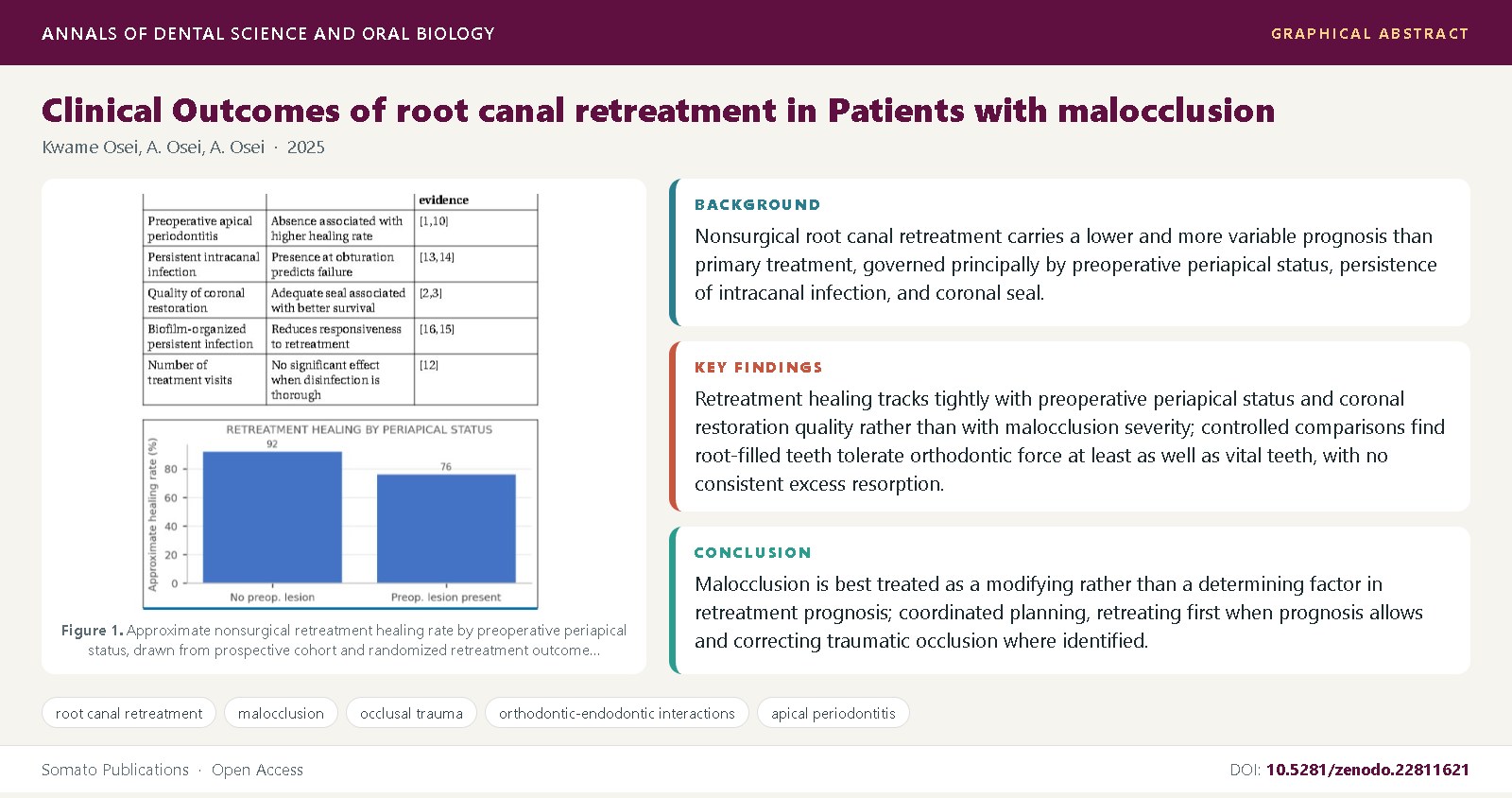
Background: Nonsurgical root canal retreatment carries a lower and more variable prognosis than primary treatment, governed principally by preoperative periapical status, persistence of intracanal infection, and coronal seal. How malocclusion and orthodontic tooth movement interact with retreatment outcomes is addressed only indirectly by the endodontic and orthodontic literatures considered separately.
Objective: To synthesize retreatment outcomes together with the orthodontic-endodontic interaction literature, characterizing retreatment prognosis specifically in patients with malocclusion.
Methods: Narrative synthesis of cohort studies, randomized trials, systematic reviews, and controlled comparative studies identified through PubMed/MEDLINE, Scopus, and Google Scholar, spanning endodontic retreatment-outcome and orthodontic root-resorption research.
Findings: Retreatment healing tracks tightly with preoperative periapical status and coronal restoration quality rather than with malocclusion severity; controlled comparisons find root-filled teeth tolerate orthodontic force at least as well as vital teeth, with no consistent excess resorption; occlusal trauma remains a plausible but poorly quantified contributor to periapical pathology.
Conclusions: Malocclusion is best treated as a modifying rather than a determining factor in retreatment prognosis; coordinated planning, retreating first when prognosis allows and correcting traumatic occlusion where identified, is supported by the comparative literature even where cohort-scale outcome data specific to this population remain limited.
References
Ng, Y.L., Mann, V., Gulabivala, K. (2010) Tooth survival following non-surgical root canal treatment: a systematic review of the literature. International Endodontic Journal, 43(3): 171-189. DOI: 10.1111/j.1365-2591.2009.01671.x
Ng, Y.L., Mann, V., Gulabivala, K. (2011) A prospective study of the factors affecting outcomes of non-surgical root canal treatment: part 2: tooth survival. International Endodontic Journal, 44(7): 610-625.
Gulabivala, K., Ng, Y.L. (2023) Factors that affect the outcomes of root canal treatment and retreatment - a reframing of the principles. International Endodontic Journal, 56(Suppl 3): 82-115. DOI: 10.1111/iej.13897
Krishnan, V. (2005) Orthodontic pain: from causes to management - a review. European Journal of Orthodontics, 27(4): 367-371.
Parashos, P. (2023) Endodontic-orthodontic interactions: a review and treatment recommendations. Australian Dental Journal, 68(3): 155-166. DOI: 10.1111/adj.12996
Parashos, P. (2024) The orthodontic-endodontic interface: trauma and pulpal considerations. British Dental Journal, 237(5): 389-397. DOI: 10.1038/s41415-024-7786-9
Cohn, S.A. (2005) Treatment choices for negative outcomes with non-surgical root canal treatment: non-surgical retreatment vs. surgical retreatment vs. implants. Endodontic Topics, 11(1): 4-24. DOI: 10.1111/j.1601-1546.2005.00163.x
Torabinejad, M., Corr, R., Handysides, R., Shabahang, S. (2009) Outcomes of nonsurgical retreatment and endodontic surgery: a systematic review. Journal of Endodontics, 35(7): 930-937.
Salehrabi, R., Rotstein, I. (2010) Epidemiologic evaluation of the outcomes of orthograde endodontic retreatment. Journal of Endodontics, 36(5): 790-792. DOI:
1016/j.joen.2010.02.009 10. Gorni, F.G., Gagliani, M.M. (2004) The outcome of endodontic retreatment: a 2-yr follow-up. Journal of Endodontics, 30(1): 1-4.
Kvist, T., Reit, C. (1999) Results of endodontic retreatment: a randomized clinical study comparing surgical and nonsurgical procedures. Journal of Endodontics, 25(12): 814-817.
Paredes-Vieyra, J., Enriquez, F.J. (2012) Success rate of singleversus two-visit RCT retreatment for teeth with apical periodontitis: a randomized controlled trial. Journal of Endodontics, 38(9): 1164-1169.
Sundqvist, G., Figdor, D., Persson, S., Sjögren, U. (1998) Microbiologic analysis of teeth with failed endodontic treatment and the outcome of conservative re-treatment. Oral Surgery, Oral Medicine, Oral Pathology, Oral Radiology, and Endodontics, 85(1): 86-93.
Sjögren, U., Figdor, D., Persson, S., Sundqvist, G. (1997) Influence of infection at the time of root filling on the outcome of endodontic treatment of teeth with apical periodontitis. International Endodontic Journal, 30(5): 297-306.
Siqueira, J.F. Jr. (2001) Aetiology of root canal treatment failure: why well-treated teeth can fail. International Endodontic Journal, 34(1): 1-10.
Ricucci, D., Siqueira, J.F. Jr. (2010) Biofilms and apical periodontitis: study of prevalence and association with clinical and histopathologic findings. Journal of Endodontics, 36(8): 1277-1288.
Setzer, F.C., Kohli, M.R., Shah, S.B., Karabucak, B., Kim, S. (2012) Outcome of endodontic surgery: a meta-analysis of the literature - Part 2: comparison of endodontic microsurgical techniques with and without the use of higher magnification. Journal of Endodontics, 38(1): 1-10.
Spurrier, S.W., Hall, S.H., Joondeph, D.R., Shapiro, P.A., Riedel, R.A. (1990) A comparison of apical root resorption during orthodontic treatment in endodontically treated and vital teeth. American Journal of Orthodontics and Dentofacial Orthopedics, 97(2): 130-134.
Weltman, B., Vig, K.W., Fields, H.W., Shanker, S., Kaizar, E.E. (2010) Root resorption associated with orthodontic tooth movement: a systematic review. American Journal of Orthodontics and Dentofacial Orthopedics, 137(4): 462-476. DOI: 10.1016/j.ajodo.2009.06.021
Mattison, G.D., Delivanis, H.P., Thacker, R.W. Jr., Hassell, K.J. (1984) Effect of orthodontic force on the pulp status of endodontically treated versus non-endodontically treated teeth. Journal of Endodontics, 10(9): 434-438.
Han, G., Hu, M., Zhang, Y., Jiang, H. (2013) Pulp vitality and histologic study of human dental pulp after the application of moderate and severe intrusive orthodontic forces. American Journal of Orthodontics and Dentofacial Orthopedics, 144(4): 518-522.
Alattas, M.H. (2023) Pulp changes secondary to orthodontic forces: a review of literature. Cureus, 15(6): e40573. DOI: 10.7759/cureus.40573

Published
Issue
Section
License
Copyright (c) 2025 Kwame Osei, et al.

This work is licensed under a Creative Commons Attribution 4.0 International License.
Unless otherwise stated on the article, all content is published under the Creative Commons Attribution 4.0 International licence (CC BY 4.0). Anyone may share (copy and redistribute the material in any medium or format) and adapt (remix, transform, and build upon the material for any purpose, including commercially), on condition that they give appropriate credit to the authors and the journal, provide a link to the licence, and indicate if changes were made. Authors retain copyright.


