
digital intraoral scanning in the Management of peri-implantitis among diabetic patients
DOI:
https://doi.org/10.5281/zenodo.22811534Keywords:
peri-implantitis, intraoral scanning, diabetes mellitus, dental implants, glycemic controlAbstract
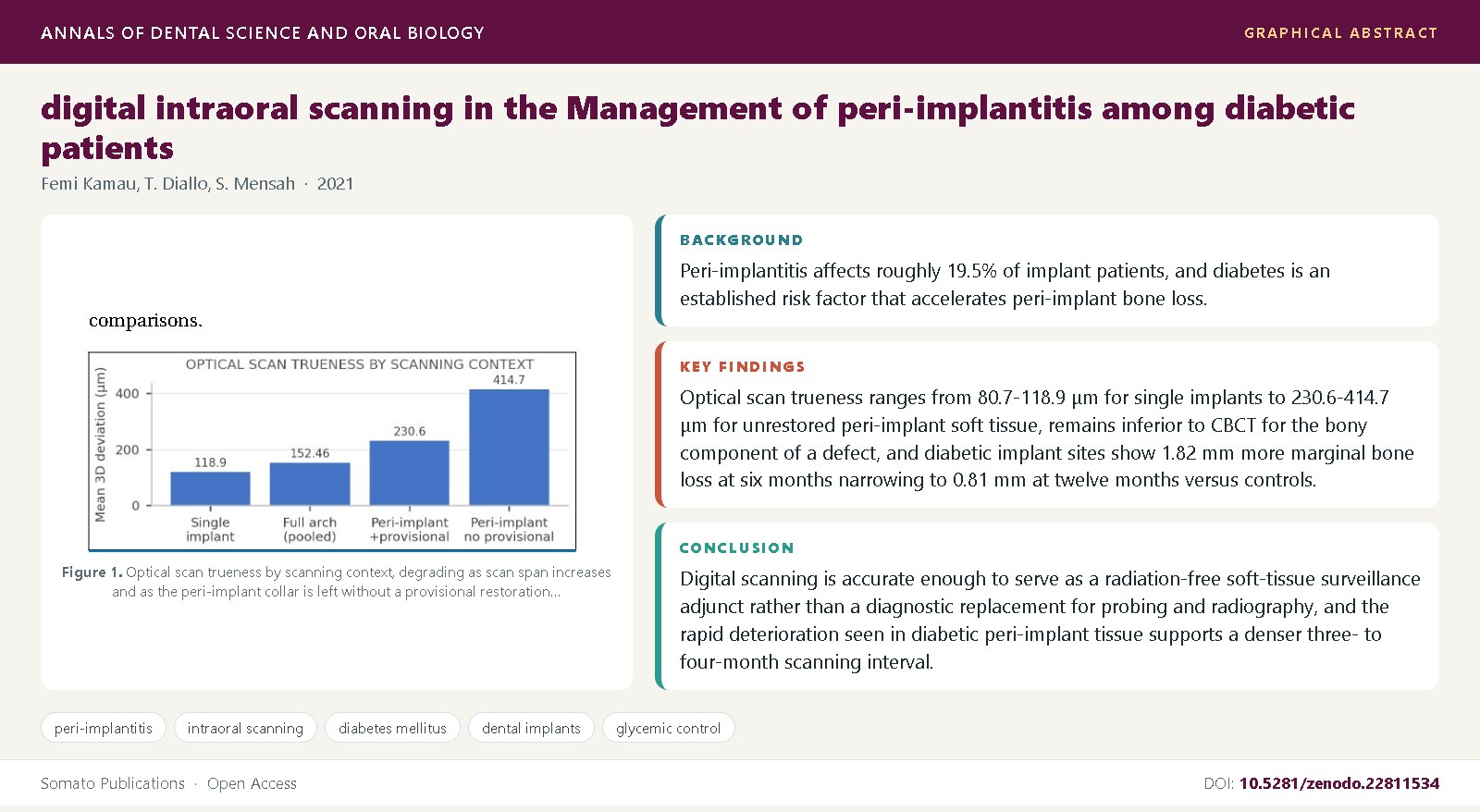
Background: Peri-implantitis affects roughly 19.5% of implant patients [1], and diabetes is an established risk factor that accelerates peri-implant bone loss [7,6].
Objective: This review synthesises the accuracy of digital intraoral scanning at peri-implant sites, compares it against conventional radiography, and evaluates the case for scanning-based surveillance tailored to diabetic patients.
Methods: We synthesised systematic reviews, meta-analyses, cohort studies, and consensus reports on scanner trueness, diabetes as a peri-implant risk modifier, and glycaemic control as a determinant of implant survival, identified through PubMed, Scopus, and Google Scholar.
Findings: Optical scan trueness ranges from 80.7-118.9 μm for single implants to 230.6-414.7 μm for unrestored peri-implant soft tissue [8,10], remains inferior to CBCT for the bony component of a defect [17], and diabetic implant sites show 1.82 mm more marginal bone loss at six months narrowing to 0.81 mm at twelve months versus controls [6], with survival falling from 100% in well-controlled to 86.3% in poorly controlled type 2 diabetes [11].
Conclusions: Digital scanning is accurate enough to serve as a radiation-free soft-tissue surveillance adjunct rather than a diagnostic replacement for probing and radiography, and the rapid deterioration seen in diabetic peri-implant tissue supports a denser three- to four-month scanning interval, a protocol not yet formally tested [2,12].
References
Diaz, P., Gonzalo, E., Gil Villagra, L.J., Miegimolle, B., Suarez, M.J. (2022) What is the prevalence of peri-implantitis? A systematic review and meta-analysis. BMC Oral Health, 22: 449. DOI: 10.1186/s12903-022-02493-8
Berglundh, T., Armitage, G., Araujo, M.G., et al. (2018) Peri-implant diseases and conditions: Consensus report of workgroup 4 of the 2017 World Workshop on the Classification of Periodontal and Peri-Implant Diseases and Conditions. Journal of Clinical Periodontology, 45(Suppl 20): S286-S291. DOI: 10.1111/jcpe.12957
Schwarz, F., Derks, J., Monje, A., Wang, H.L. (2018) Peri-implantitis. Journal of Clinical Periodontology, 45(Suppl 20): S246-S266. DOI: 10.1111/jcpe.12954
Heitz-Mayfield, L.J.A. (2008) Peri-implant diseases: diagnosis and risk indicators. Journal of Clinical Periodontology, 35(Suppl 8): 292-304. DOI: 10.1111/j.1600-051X.2008.01275.x
Preshaw, P.M., Alba, A.L., Herrera, D., Jepsen, S., Konstantinidis, A., Makrilakis, K., Taylor, R. (2012) Periodontitis and diabetes: a two-way relationship. Diabetologia, 55(1): 21-31. DOI: 10.1007/s00125-011-2342-y
Dioguardi, M., Cantore, S., Scacco, S., Quarta, C., Sovereto, D., et al. (2022) From Bench to Bedside in Precision Medicine: Diabetes Mellitus and Peri-Implantitis Clinical Indices with a Short-Term Follow-Up: A Systematic Review and Meta-Analysis. Journal of Personalized Medicine, 12(2): 235. DOI: 10.3390/jpm12020235
Monje, A., Catena, A., Borgnakke, W.S. (2017) Association between diabetes mellitus/hyperglycaemia and peri-implant diseases: Systematic review and meta-analysis. Journal of Clinical Periodontology, 44(6): 636-648. DOI: 10.1111/jcpe.12724
Ma, J., Zhang, B., Song, H., Wu, D., Song, T. (2023) Accuracy of digital implant impressions obtained using intraoral scanners: a systematic review and meta-analysis of in vivo studies. International Journal of Implant Dentistry, 9: 48. DOI: 10.1186/s40729-023-00517-8
Pesce, P., Nicolini, P., Caponio, V.C.A., Zecca, P.A., Canullo, L., et al. (2024) Accuracy of Full-Arch Intraoral Scans Versus Conventional Impression: A Systematic Review with a Meta-Analysis. Journal of Clinical Medicine, 14(1): 71. DOI:
3390/jcm14010071 10. Shomurodov, K., Mirkhusanova, R., Bekmurodov, E., Idiev, O. (2026) Intraoral Scanners for Three-Dimensional Assessment of Peri-Implant Soft Tissues: A Systematic Review of Clinical Studies. Journal of Clinical and Experimental Dentistry, 18(6): e833-e841. DOI: 10.4317/jced.64074
Cosola, S., Butera, A., Zergaw, A.H., George, J., Covani, U., Arrighi, A., Toti, P., Scribante, A., Menchini-Fabris, G.B. (2025) Glycemic Control and Implant Stability in Patients with Type II Diabetes: Narrative Review. Healthcare, 13(5): 449. DOI: 10.3390/healthcare13050449
Oates, T.W., Dowell, S., Robinson, M., McMahan, C.A. (2009) Glycemic Control and Implant Stabilization in Type 2 Diabetes Mellitus. Journal of Dental Research, 88(4): 367-371. DOI: 10.1177/0022034509334203
Mangano, F., Gandolfi, A., Luongo, G., Logozzo, S. (2017) Intraoral scanners in dentistry: a review of the current literature. BMC Oral Health, 17: 149. DOI: 10.1186/s12903-017-0442-x
Joda, T., Bragger, U. (2015) Digital vs. conventional implant prosthetic workflows: a cost/time analysis. Clinical Oral Implants Research, 26(12): 1430-1435. DOI: 10.1111/clr.12476
Ender, A., Mehl, A. (2013) Accuracy of complete-arch dental impressions: a new method of measuring trueness and precision. Journal of Prosthetic Dentistry, 109(2): 121-128. DOI: 10.1016/S0022-3913(13)60028-1
Papaspyridakos, P., Gallucci, G.O., Chen, C.J., Hanssen, S., Naert, I., Vandenberghe, B. (2016) Digital versus conventional implant impressions for edentulous patients: accuracy outcomes. Clinical Oral Implants Research, 27(4): 465-472. DOI: 10.1111/clr.12567
Tayman, M.A., Kamburoglu, K., Cakmak, E.E. (2026) Comparative evaluation of direct and digital measurements of peri-implant defects using CBCT, ultrasound, and intraoral scanning. Dentomaxillofacial Radiology, 55(4): 370-380. DOI: 10.1093/dmfr/twag006
Vera, M., Gomez-Silva, M.J., Vera, V., Lopez-Gonzalez, C.I., Aliaga, I., et al. (2023) Artificial Intelligence Techniques for Automatic Detection of Peri-implant Marginal Bone Remodeling in Intraoral Radiographs. Journal of Digital Imaging, 36(5): 2259-2277. DOI: 10.1007/s10278-023-00880-3
Ferreira, S.D., Silva, G.L., Cortelli, J.R., Costa, J.E., Costa, F.O. (2006) Prevalence and risk variables for peri-implant disease in Brazilian subjects. Journal of Clinical Periodontology, 33(12): 929-935. DOI: 10.1111/j.1600-051X.2006.01001.x
Chrcanovic, B.R., Albrektsson, T., Wennerberg, A. (2014) Diabetes and Oral Implant Failure: A Systematic Review. Journal of Dental Research, 93(9): 859-867. DOI: 10.1177/0022034514538820
Naujokat, H., Kunzendorf, B., Wiltfang, J. (2016) Dental implants and diabetes mellitus-a systematic review. International Journal of Implant Dentistry, 2: 5. DOI: 10.1186/s40729-016-0038-2
Barbato, L., Cavalcanti, R., Rupe, C., Scartabelli, D., Serni, L., Chambrone, L., Cairo, F. (2023) Clinical efficacy of adjunctive methods for the non-surgical treatment of peri-implantitis: a systematic review and meta-analysis. BMC Oral Health, 23: 375. DOI: 10.1186/s12903-023-03058-z
Lindhe, J., Meyle, J. (2008) Peri-implant diseases: Consensus Report of the Sixth European Workshop on Periodontology. Journal of Clinical Periodontology, 35(Suppl 8): 282-285. DOI: 10.1111/j.1600-051X.2008.01283.x
Schwarz, F., Alcoforado, G., Nelson, K., et al. (2021) Peri-implantitis: 6th EAO Consensus Conference. Clinical Oral Implants Research, 32(Suppl 21): 245-253. DOI: 10.1111/clr.13827

Published
Issue
Section
License
Copyright (c) 2021 Femi Kamau, et al.

This work is licensed under a Creative Commons Attribution 4.0 International License.
Unless otherwise stated on the article, all content is published under the Creative Commons Attribution 4.0 International licence (CC BY 4.0). Anyone may share (copy and redistribute the material in any medium or format) and adapt (remix, transform, and build upon the material for any purpose, including commercially), on condition that they give appropriate credit to the authors and the journal, provide a link to the licence, and indicate if changes were made. Authors retain copyright.


