
Evaluation of HbA1c trend analysis as a Prognostic Tool in type 2 diabetes mellitus
DOI:
https://doi.org/10.5281/zenodo.22812628Keywords:
HbA1c, glycemic variability, type 2 diabetes mellitus, prognosis, cardiovascular outcomesAbstract
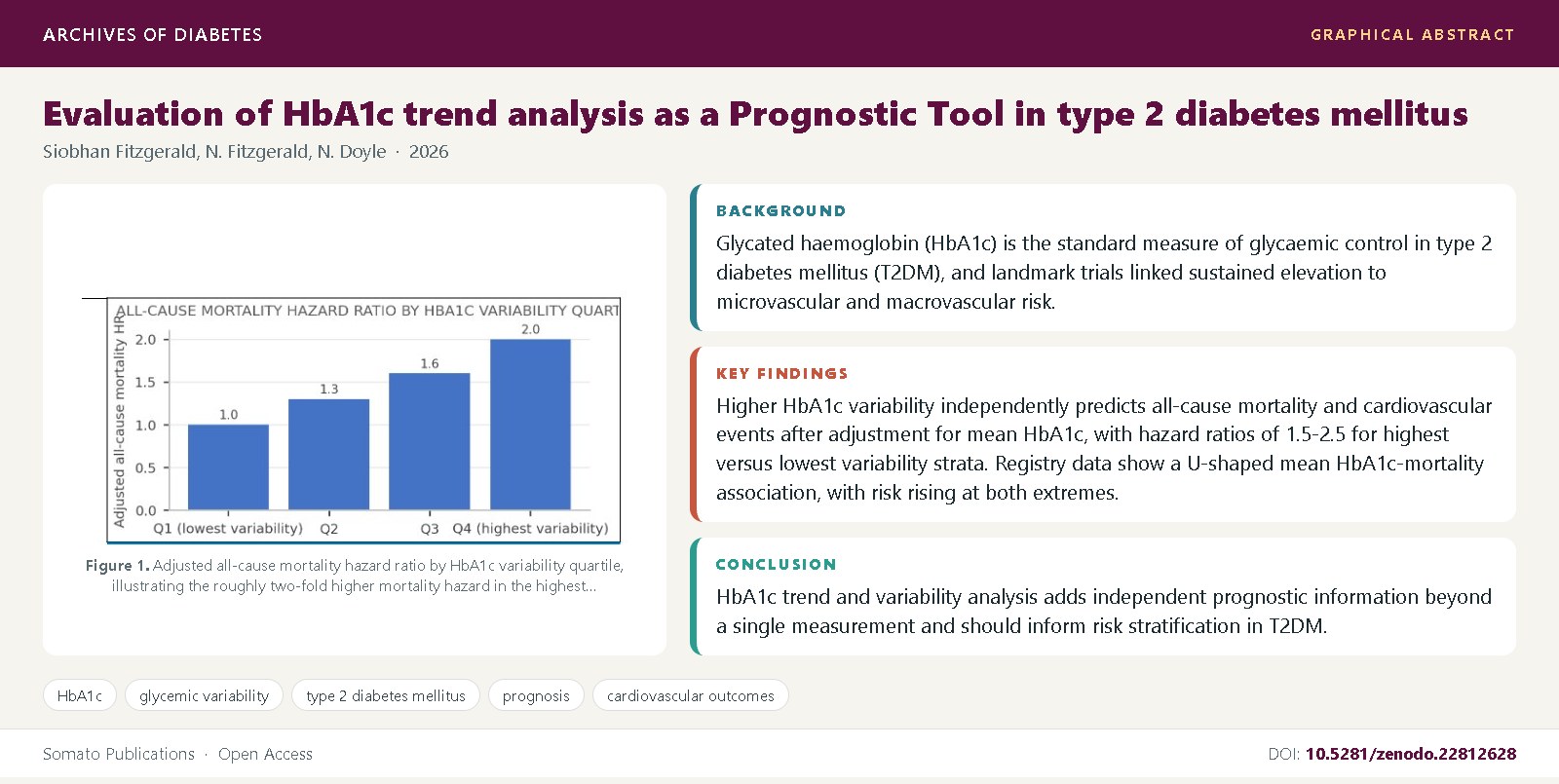
Background: Glycated haemoglobin (HbA1c) is the standard measure of glycaemic control in type 2 diabetes mellitus (T2DM), and landmark trials linked sustained elevation to microvascular and macrovascular risk [2,3]. The longitudinal trend and visit-to-visit variability of HbA1c are increasingly examined as independent prognostic signals.
Objective: This review evaluates HbA1c trend and variability analysis as a prognostic tool for mortality and vascular complications in T2DM, compared with single-timepoint HbA1c and continuous glucose monitoring (CGM) metrics.
Methods: We synthesized major randomized trials, prospective and retrospective cohorts, and registry analyses addressing HbA1c trajectory, variability, and outcomes in adults with T2DM.
Findings: Higher HbA1c variability independently predicts all-cause mortality and cardiovascular events after adjustment for mean HbA1c [10,11,12], with hazard ratios of 1.5-2.5 for highest versus lowest variability strata. Registry data show a U-shaped mean HbA1c-mortality association, with risk rising at both extremes [16]. CGM-derived metrics complement but do not replace HbA1c trend analysis [26,27].
Conclusions: HbA1c trend and variability analysis adds independent prognostic information beyond a single measurement and should inform risk stratification in T2DM [17,13].
References
The Diabetes Control and Complications Trial Research Group (1993) The effect of intensive treatment of diabetes on the development and progression of long-term complications in insulin-dependent diabetes mellitus. New England Journal of Medicine, 329(14): 977-986. DOI: 10.1056/NEJM199309303291401
UK Prospective Diabetes Study (UKPDS) Group (1998) Intensive blood-glucose control with sulphonylureas or insulin compared with conventional treatment and risk of complications in patients with type 2 diabetes (UKPDS 33). Lancet, 352(9131): 837-853.
Stratton, I.M., Adler, A.I., Neil, H.A., Matthews, D.R., Manley, S.E., Cull, C.A., et al. (2000) Association of glycaemia with macrovascular and microvascular complications of type 2 diabetes (UKPDS 35): prospective observational study. BMJ, 321(7258): 405-412. DOI: 10.1136/bmj.321.7258.405
Holman, R.R., Paul, S.K., Bethel, M.A., Matthews, D.R., Neil, H.A. (2008) 10-year follow-up of intensive glucose control in type 2 diabetes. New England Journal of Medicine, 359(15): 1577-1589. DOI: 10.1056/NEJMoa0806470
Action to Control Cardiovascular Risk in Diabetes (ACCORD) Study Group (2008) Effects of intensive glucose lowering in type 2 diabetes. New England Journal of Medicine, 358(24): 2545-2559. DOI: 10.1056/NEJMoa0802743
ADVANCE Collaborative Group (2008) Intensive blood glucose control and vascular outcomes in patients with type 2 diabetes. New England Journal of Medicine, 358(24): 2560-2572. DOI: 10.1056/NEJMoa0802987
Duckworth, W., Abraira, C., Moritz, T., Reda, D., Emanuele, N., Reaven, P.D., et al. (2009) Glucose control and vascular complications in veterans with type 2 diabetes. New England Journal of Medicine, 360(2): 129-139. DOI: 10.1056/NEJMoa0808431
Kilpatrick, E.S., Rigby, A.S., Atkin, S.L. (2006) The effect of glucose variability on the risk of microvascular complications in type 1 diabetes. Diabetes Care, 29(7): 1486-1490. DOI: 10.2337/dc06-0293
Kilpatrick, E.S., Rigby, A.S., Atkin, S.L. (2008) A1C variability and the risk of microvascular complications in type 1 diabetes: data from the Diabetes Control and Complications Trial. Diabetes Care, 31(11): 2198-2202. DOI:
2337/dc08-0864 10. Orsi, E., Solini, A., Bonora, E., Fondelli, C., Trevisan, R., Vedovato, M., et al. (2018) Haemoglobin A1c variability is a strong, independent predictor of all-cause mortality in patients with type 2 diabetes. Diabetes Care, 41(5): 962-969. DOI: 10.2337/dc17-1148
Skriver, M.V., Sandbaek, A., Kristensen, J.K., Stovring, H. (2015) HbA1c variability and risk of cardiovascular events and mortality in patients with type 2 diabetes: a Danish population-based cohort study. Diabetologia, 58(11): 2445-2453. DOI: 10.1007/s00125-015-3719-6
Gorst, C., Kwok, C.S., Aslam, S., Buchan, I., Kontopantelis, E., Myint, P.K., et al. (2015) Long-term glycemic variability and risk of adverse outcomes: a systematic review and meta-analysis. Diabetes Care, 38(12): 2354-2369. DOI: 10.2337/dc15-1188
Hirakawa, Y., Arima, H., Zoungas, S., Ninomiya, T., Cooper, M., Hamet, P., et al. (2014) Impact of visit-to-visit glycemic variability on the risks of macrovascular and microvascular events and all-cause mortality in type 2 diabetes: the ADVANCE trial. Diabetes Care, 37(8): 2359-2365. DOI: 10.2337/dc14-0199
Waden, J., Forsblom, C., Thorn, L.M., Gordin, D., Saraheimo, M., Groop, P.H. (2009) A1C variability predicts incident cardiovascular events, microalbuminuria, and overt diabetic nephropathy in patients with type 1 diabetes. Diabetes, 58(11): 2649-2655. DOI: 10.2337/db09-0693
Takao, T., Ide, T., Yanagisawa, H., Kikuchi, M., Kawazu, S., Matsuyama, Y. (2014) The effect of fasting plasma glucose variability on the risk of retinopathy in type 2 diabetic patients: retrospective long-term follow-up. Diabetes Research and Clinical Practice, 105(3): 402-408. DOI: 10.1016/j.diabres.2014.06.007
Currie, C.J., Peters, J.R., Tynan, A., Evans, M., Heine, R.J., Bracco, O.L., et al. (2010) Survival as a function of HbA1c in people with type 2 diabetes: a retrospective cohort study. Lancet, 375(9713): 481-489. DOI: 10.1016/S0140-6736(09)61969-3
Rawshani, A., Rawshani, A., Franzen, S., Sattar, N., Eliasson, B., Svensson, A.M., et al. (2018) Risk factors, mortality, and cardiovascular outcomes in patients with type 2 diabetes. New England Journal of Medicine, 379(7): 633-644. DOI: 10.1056/NEJMoa1800256
Selvin, E., Steffes, M.W., Zhu, H., Matsushita, K., Wagenknecht, L., Pankow, J., et al. (2010) Glycated hemoglobin, diabetes, and cardiovascular risk in nondiabetic adults. New England Journal of Medicine, 362(9): 800-811. DOI: 10.1056/NEJMoa0908359
Khaw, K.T., Wareham, N., Bingham, S., Luben, R., Welch, A., Day, N. (2004) Association of hemoglobin A1c with cardiovascular disease and mortality in adults: the European prospective investigation into cancer in Norfolk. Annals of Internal Medicine, 141(6): 413-420. DOI: 10.7326/0003-4819-141-6-200409210-00006
Cavero-Redondo, I., Peleteiro, B., Alvarez-Bueno, C., Rodriguez-Artalejo, F., Martinez-Vizcaino, V. (2017) Glycated haemoglobin A1c as a risk factor of cardiovascular outcomes and all-cause mortality in diabetic and non-diabetic populations: a systematic review and meta-analysis. BMJ Open, 7(7): e015949. DOI: 10.1136/bmjopen-2017-015949
Zoungas, S., Chalmers, J., Neal, B., Billot, L., Li, Q., Hirakawa, Y., et al. (2014) Follow-up of blood-pressure lowering and glucose control in type 2 diabetes. New England Journal of Medicine, 371(15): 1392-1406. DOI: 10.1056/NEJMoa1407963
Nathan, D.M., Kuenen, J., Borg, R., Zheng, H., Schoenfeld, D., Heine, R.J. (2008) Translating the A1C assay into estimated average glucose values. Diabetes Care, 31(8): 1473-1478. DOI: 10.2337/dc08-0545
Sacks, D.B., Arnold, M., Bakris, G.L., Bruns, D.E., Horvath, A.R., Kirkman, M.S., et al. (2011) Guidelines and recommendations for laboratory analysis in the diagnosis and management of diabetes mellitus. Clinical Chemistry, 57(6): e1-e47. DOI: 10.1373/clinchem.2010.161596
International Expert Committee (2009) International Expert Committee report on the role of the A1C assay in the diagnosis of diabetes. Diabetes Care, 32(7): 1327-1334. DOI: 10.2337/dc09-9033
World Health Organization (2011) Use of Glycated Haemoglobin (HbA1c) in the Diagnosis of Diabetes Mellitus: Abbreviated Report of a WHO Consultation. World Health Organization, Geneva.
Beck, R.W., Bergenstal, R.M., Cheng, P., Kollman, C., Carlson, A.L., Johnson, M.L., et al. (2019) Clinical targets for continuous glucose monitoring data interpretation: recommendations from the International Consensus on Time in Range. Diabetes Care, 42(8): 1593-1603. DOI: 10.2337/dci19-0028
Bergenstal, R.M., Beck, R.W., Close, K.L., Grunberger, G., Sacks, D.B., Kowalski, A., et al. (2018) Glucose Management Indicator (GMI): a new term for estimating A1C from continuous glucose monitoring. Diabetes Care, 41(11): 2275-2280. DOI: 10.2337/dc18-1581
Sherwani, S.I., Khan, H.A., Ekhzaimy, A., Masood, A., Sakharkar, M.K. (2016) Significance of HbA1c test in diagnosis and prognosis of diabetic patients. Biomarker Insights, 11: 95-104. DOI: 10.4137/BMI.S38440
Cederberg, H., Saukkonen, T., Laakso, M., Jokelainen, J., Harkonen, P., Timonen, M., et al. (2010) Postchallenge glucose, HbA1c, and fasting glucose as predictors of type 2 diabetes and cardiovascular disease: a 10-year prospective cohort study. Diabetes Care, 33(9): 2077-2083. DOI: 10.2337/dc10-0262
Bonora, E., Tuomilehto, J. (2011) The pros and cons of diagnosing diabetes with A1C. Diabetes Care, 34(Suppl 2): S184-S190. DOI: 10.2337/dc11-s216
American Diabetes Association Professional Practice Committee (2023) Standards of Care in Diabetes-2023. Diabetes Care, 46(Suppl 1): S1-S291. DOI: 10.2337/dc23-Sint
Wan, E.Y.F., Fung, C.S.C., Yu, E.Y.T., Chin, W.Y., Fong, D.Y.T., Chan, A.K.C., et al. (2020) Effect of visit-to-visit glycemic variability on the development of diabetic retinopathy and cardiovascular disease in patients with type 2 diabetes mellitus. Diabetes Care, 43(10): 2444-2452. DOI: 10.2337/dc20-0308

Published
Issue
Section
License
Copyright (c) 2026 Siobhan Fitzgerald, et al.

This work is licensed under a Creative Commons Attribution 4.0 International License.


