
HbA1c trend analysis in the Management of insulin resistance among elderly patients with diabetes
DOI:
https://doi.org/10.5281/zenodo.22812656Keywords:
HbA1c, insulin resistance, elderly, type 2 diabetes, glycemic controlAbstract
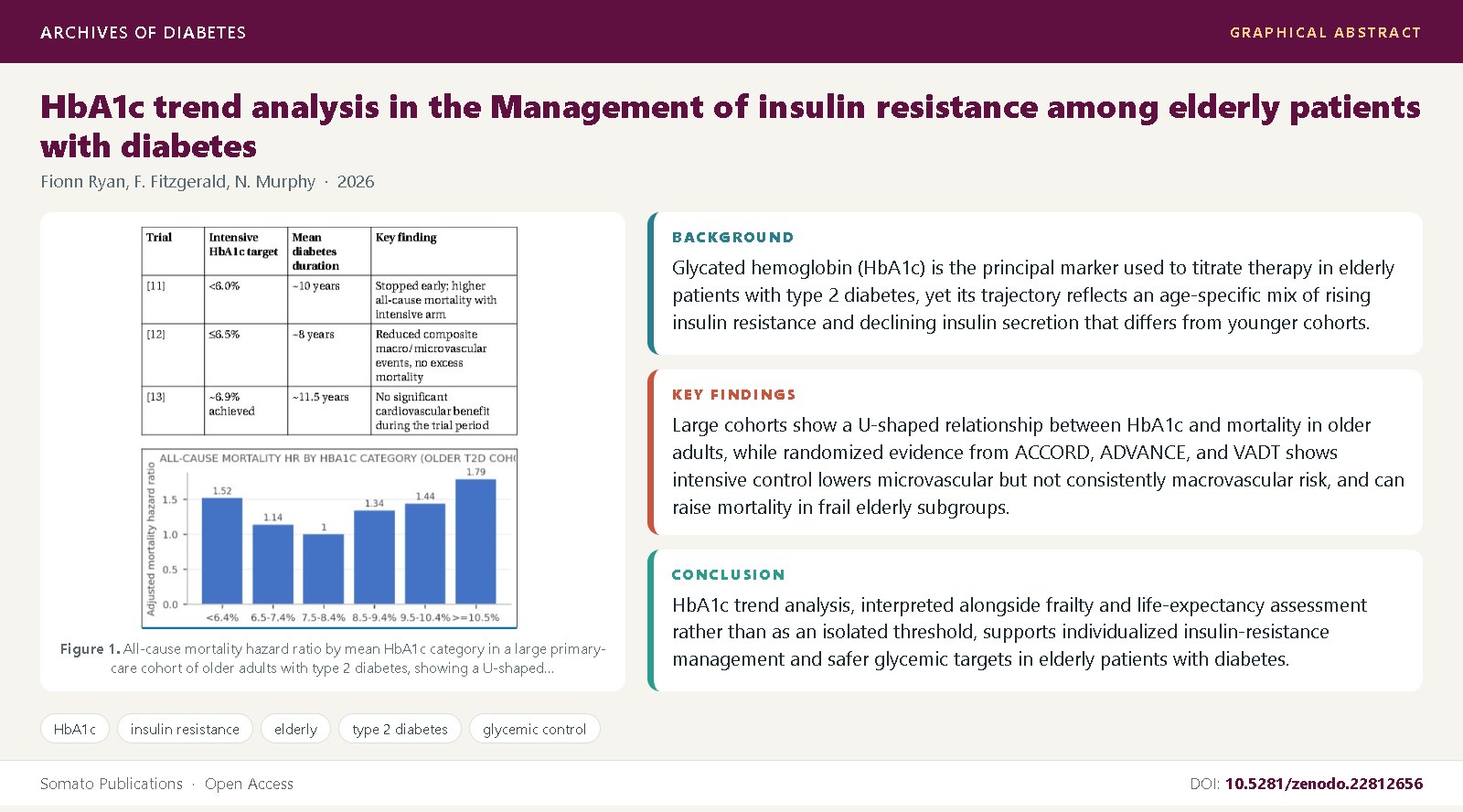
Background: Glycated hemoglobin (HbA1c) is the principal marker used to titrate therapy in elderly patients with type 2 diabetes, yet its trajectory reflects an age-specific mix of rising insulin resistance and declining insulin secretion that differs from younger cohorts.
Objective: This review synthesizes evidence on HbA1c trend analysis as a tool for monitoring insulin resistance and guiding individualized glycemic targets in older adults with diabetes.
Methods: We synthesized landmark randomized trials of intensive glycemic control, observational cohorts relating HbA1c trajectory to mortality, and consensus guidelines on target individualization in geriatric diabetes care.
Findings: Large cohorts show a U-shaped relationship between HbA1c and mortality in older adults, while randomized evidence from ACCORD, ADVANCE, and VADT shows intensive control lowers microvascular but not consistently macrovascular risk, and can raise mortality in frail elderly subgroups. Age-related increases in insulin resistance combine with declining beta-cell reserve to produce trend patterns that guideline bodies now use to stratify targets by functional status.
Conclusions: HbA1c trend analysis, interpreted alongside frailty and life-expectancy assessment rather than as an isolated threshold, supports individualized insulin-resistance management and safer glycemic targets in elderly patients with diabetes.
References
DCCT Research Group. (1993) The effect of intensive treatment of diabetes on the development and progression of long-term complications in insulin-dependent diabetes mellitus. New England Journal of Medicine, 329(14): 977-986. DOI: 10.1056/NEJM199309303291401
UK Prospective Diabetes Study (UKPDS) Group. (1998) Intensive blood-glucose control with sulphonylureas or insulin compared with conventional treatment and risk of complications in patients with type 2 diabetes (UKPDS 33). Lancet, 352(9131): 837-853.
Stratton, I.M., Adler, A.I., Neil, H.A., Matthews, D.R., Manley, S.E., Cull, C.A., et al. (2000) Association of glycaemia with macrovascular and microvascular complications of type 2 diabetes (UKPDS 35): prospective observational study. BMJ, 321(7258): 405-412. DOI: 10.1136/bmj.321.7258.405
DeFronzo, R.A. (2009) Banting Lecture. From the triumvirate to the ominous octet: a new paradigm for the treatment of type 2 diabetes mellitus. Diabetes, 58(4): 773-795. DOI: 10.2337/db09-9028
Kahn, S.E. (2003) The relative contributions of insulin resistance and beta-cell dysfunction to the pathophysiology of Type 2 diabetes. Diabetologia, 46(1): 3-19. DOI: 10.1007/s00125-002-1009-0
Chang, A.M., Halter, J.B. (2003) Aging and insulin secretion. American Journal of Physiology-Endocrinology and Metabolism, 284(1): E7-E12. DOI: 10.1152/ajpendo.00366.2002
Halter, J.B., Musi, N., McFarland Horne, F., Crandall, J.P., Goldberg, A., Harkless, L., et al. (2014) Diabetes and cardiovascular disease in older adults: current status and future directions. Diabetes, 63(8): 2578-2589. DOI: 10.2337/db14-0020
Lee, S.J., Eng, C. (2011) Goals of glycemic control in frail older patients with diabetes. JAMA, 305(13): 1350-1351. DOI: 10.1001/jama.2011.404
Bandeen-Roche, K., Xue, Q.L., Ferrucci, L., Walston, J., Guralnik, J.M., Chaves, P., et al. (2006) Phenotype of frailty: characterization in the women's health and aging studies. Journals of Gerontology Series A: Biological Sciences and Medical Sciences, 61(3): 262-266. DOI:
1093/gerona/61.3.262 10. Currie, C.J., Peters, J.R., Tynan, A., Evans, M., Heine, R.J., Bracco, O.L., et al. (2010) Survival as a function of HbA1c in people with type 2 diabetes: a retrospective cohort study. Lancet, 375(9713): 481-489. DOI: 10.1016/S0140-6736(09)61969-3
Action to Control Cardiovascular Risk in Diabetes Study Group. (2008) Effects of intensive glucose lowering in type 2 diabetes. New England Journal of Medicine, 358(24): 2545-2559. DOI: 10.1056/NEJMoa0802743
ADVANCE Collaborative Group. (2008) Intensive blood glucose control and vascular outcomes in patients with type 2 diabetes. New England Journal of Medicine, 358(24): 2560-2572. DOI: 10.1056/NEJMoa0802987
Duckworth, W., Abraira, C., Moritz, T., Reda, D., Emanuele, N., Reaven, P.D., et al. (2009) Glucose control and vascular complications in veterans with type 2 diabetes. New England Journal of Medicine, 360(2): 129-139. DOI: 10.1056/NEJMoa0808431
Matthews, D.R., Hosker, J.P., Rudenski, A.S., Naylor, B.A., Treacher, D.F., Turner, R.C. (1985) Homeostasis model assessment: insulin resistance and beta-cell function from fasting plasma glucose and insulin concentrations in man. Diabetologia, 28(7): 412-419. DOI: 10.1007/BF00280883
Ferrannini, E., Natali, A., Bell, P., Cavallo-Perin, P., Lalic, N., Mingrone, G. (1997) Insulin resistance and hypersecretion in obesity. European Group for the Study of Insulin Resistance (EGIR). Journal of Clinical Investigation, 100(5): 1166-1173. DOI: 10.1172/JCI119628
Barzilai, N., Ferrucci, L. (2012) Insulin resistance and aging: a cause or a protective response? Journals of Gerontology Series A: Biological Sciences and Medical Sciences, 67(12): 1329-1331. DOI: 10.1093/gerona/gls145
Meneilly, G.S., Elahi, D. (2005) Metabolic alterations in middle-aged and elderly lean patients with type 2 diabetes. Diabetes Care, 28(6): 1498-1499. DOI: 10.2337/diacare.28.6.1498
Ismail-Beigi, F., Craven, T., Banerji, M.A., Basile, J., Calles, J., Cohen, R.M., et al. (2010) Effect of intensive treatment of hyperglycaemia on microvascular outcomes in type 2 diabetes: an analysis of the ACCORD randomised trial. Lancet, 376(9739): 419-430. DOI: 10.1016/S0140-6736(10)60576-4
Huang, E.S., Laiteerapong, N., Liu, J.Y., John, P.M., Moffet, H.H., Karter, A.J. (2014) Rates of complications and mortality in older patients with diabetes mellitus: the diabetes and aging study. JAMA Internal Medicine, 174(2): 251-258. DOI: 10.1001/jamainternmed.2013.12956
Lipska, K.J., Ross, J.S., Miao, Y., Shah, N.D., Lee, S.J., Steinman, M.A. (2015) Potential overtreatment of diabetes mellitus in older adults with tight glycemic control. JAMA Internal Medicine, 175(3): 356-362. DOI: 10.1001/jamainternmed.2014.7345
Selvin, E., Marinopoulos, S., Berkenblit, G., Rami, T., Brancati, F.L., Powe, N.R., et al. (2004) Meta-analysis: glycosylated hemoglobin and cardiovascular disease in diabetes mellitus. Annals of Internal Medicine, 141(6): 421-431. DOI: 10.7326/0003-4819-141-6-200409210-00007
Monnier, L., Mas, E., Ginet, C., Michel, F., Villon, L., Cristol, J.P., et al. (2006) Activation of oxidative stress by acute glucose fluctuations compared with sustained chronic hyperglycemia in patients with type 2 diabetes. JAMA, 295(14): 1681-1687. DOI: 10.1001/jama.295.14.1681
Kilpatrick, E.S., Rigby, A.S., Atkin, S.L. (2006) The effect of glucose variability on the risk of microvascular complications in type 1 diabetes. Diabetes Care, 29(7): 1486-1490. DOI: 10.2337/dc06-0293
Kirkman, M.S., Briscoe, V.J., Clark, N., Florez, H., Haas, L.B., Halter, J.B., et al. (2012) Diabetes in older adults. Diabetes Care, 35(12): 2650-2664. DOI: 10.2337/dc12-1801
Sinclair, A.J., Paolisso, G., Castro, M., Bourdel-Marchasson, I., Gadsby, R., Rodriguez-Manas, L. (2011) European Diabetes Working Party for Older People 2011 clinical guidelines for type 2 diabetes mellitus. Executive summary. Diabetes & Metabolism, 37(S3): S27-S38. DOI: 10.1016/S1262-3636(11)70962-4
American Geriatrics Society Expert Panel on the Care of Older Adults with Diabetes Mellitus. (2013) Guidelines abstracted from the American Geriatrics Society guidelines for improving the care of older adults with diabetes mellitus. Journal of the American Geriatrics Society, 61(11): 2020-2026. DOI: 10.1111/jgs.12514
Munshi, M.N., Florez, H., Huang, E.S., Kalyani, R.R., Mupanomunda, M., Pandya, N., et al. (2016) Management of diabetes in long-term care and skilled nursing facilities: a position statement of the American Diabetes Association. Diabetes Care, 39(2): 308-318. DOI: 10.2337/dc15-2512
American Diabetes Association Professional Practice Committee. (2023) 6. Glycemic targets: standards of care in diabetes-2023. Diabetes Care, 46(Suppl 1): S97-S110. DOI: 10.2337/dc23-S006
American Diabetes Association Professional Practice Committee. (2024) 13. Older adults: standards of care in diabetes-2024. Diabetes Care, 47(Suppl 1): S244-S257. DOI: 10.2337/dc24-S013
ORIGIN Trial Investigators. (2012) Basal insulin and cardiovascular and other outcomes in dysglycemia. New England Journal of Medicine, 367(4): 319-328. DOI: 10.1056/NEJMoa1203858
Turner, R.C., Cull, C.A., Frighi, V., Holman, R.R. (1999) Glycemic control with diet, sulfonylurea, metformin, or insulin in patients with type 2 diabetes mellitus: progressive requirement for multiple therapies (UKPDS 49). JAMA, 281(21): 2005-2012. DOI: 10.1001/jama.281.21.2005
Yakaryilmaz, F.D., Ozturk, Z.A. (2017) Treatment of type 2 diabetes mellitus in the elderly. World Journal of Diabetes, 8(6): 278-285. DOI: 10.4239/wjd.v8.i6.278
Chiniwala, N., Jabbour, S. (2011) Management of diabetes mellitus in the elderly. Current Opinion in Endocrinology, Diabetes and Obesity, 18(2): 148-152. DOI: 10.1097/MED.0b013e3283444fbd
Rodriguez-Gutierrez, R., Montori, V.M. (2016) Glycemic control for patients with type 2 diabetes mellitus: our evolving faith in the face of evidence. Circulation: Cardiovascular Quality and Outcomes, 9(5): 504-512. DOI: 10.1161/CIRCOUTCOMES.116.002901
Boyle, J.P., Thompson, T.J., Gregg, E.W., Barker, L.E., Williamson, D.F. (2010) Projection of the year 2050 burden of diabetes in the US adult population: dynamic modeling of incidence, mortality, and prediabetes prevalence. Population Health Metrics, 8: 29. DOI: 10.1186/1478-7954-8-29

Published
Issue
Section
License
Copyright (c) 2026 Fionn Ryan, et al.

This work is licensed under a Creative Commons Attribution 4.0 International License.


