
Comparative Analysis of GLP-1 receptor agonist therapy versus Standard Care in gestational diabetes
DOI:
https://doi.org/10.5281/zenodo.22812581Keywords:
gestational diabetes, GLP-1 receptor agonist, insulin, metformin, standard careAbstract
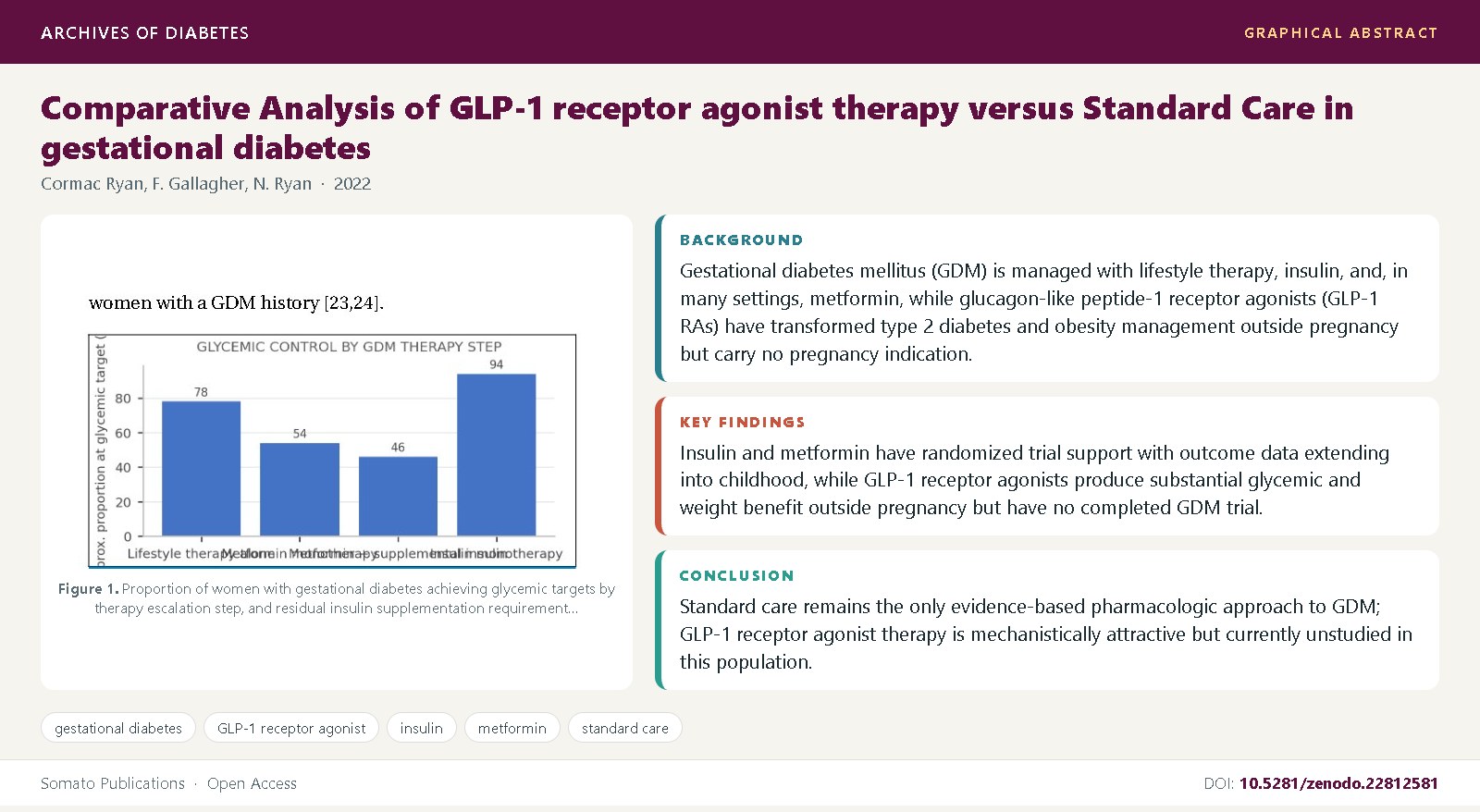
Background: Gestational diabetes mellitus (GDM) is managed with lifestyle therapy, insulin, and, in many settings, metformin, while glucagon-like peptide-1 receptor agonists (GLP-1 RAs) have transformed type 2 diabetes and obesity management outside pregnancy but carry no pregnancy indication.
Objective: This review compares the evidence base for GLP-1 receptor agonist therapy against standard care in gestational diabetes, characterizing what is and is not currently known about the class in this population.
Methods: We synthesized randomized trials and meta-analyses of standard GDM pharmacotherapy, GLP-1 receptor agonist mechanism and non-pregnancy efficacy data, pregnancy-exposure pharmacovigilance evidence, product labelling, and major clinical practice guidelines.
Findings: Insulin and metformin have randomized trial support with outcome data extending into childhood, while GLP-1 receptor agonists produce substantial glycemic and weight benefit outside pregnancy but have no completed GDM trial and are excluded from pregnancy use by every major guideline because of animal reproductive toxicology signals and minimal human exposure data.
Conclusions: Standard care remains the only evidence-based pharmacologic approach to GDM; GLP-1 receptor agonist therapy is mechanistically attractive but currently unstudied in this population, and the present comparison functions as a roadmap for future research rather than a basis for practice change.
References
Sacks DA, Hadden DR, Maresh M, et al. (2012) Frequency of gestational diabetes mellitus at collaborating centers based on IADPSG consensus panel-recommended criteria: the Hyperglycemia and Adverse Pregnancy Outcome (HAPO) Study. Diabetes Care, 35(3): 526-528.
Metzger BE, Gabbe SG, Persson B, et al. (2010) International association of diabetes and pregnancy study groups recommendations on the diagnosis and classification of hyperglycemia in pregnancy. Diabetes Care, 33(3): 676-682.
HAPO Study Cooperative Research Group, Metzger BE, Lowe LP, et al. (2008) Hyperglycemia and adverse pregnancy outcomes. New England Journal of Medicine, 358(19): 1991-2002. DOI: 10.1056/NEJMoa0707943
American College of Obstetricians and Gynecologists (2018) ACOG Practice Bulletin No. 190: Gestational Diabetes Mellitus. Obstetrics and Gynecology, 131(2): e49-e64.
Rowan JA, Hague WM, Gao W, Battin MR, Moore MP; MiG Trial Investigators (2008) Metformin versus insulin for the treatment of gestational diabetes. New England Journal of Medicine, 358(19): 2003-2015. DOI: 10.1056/NEJMoa0707193
Langer O, Conway DL, Berkus MD, Xenakis EM, Gonzales O (2000) A comparison of glyburide and insulin in women with gestational diabetes mellitus. New England Journal of Medicine, 343(16): 1134-1138. DOI: 10.1056/NEJM200010193431601
Rowan JA, Rush EC, Plank LD, et al. (2018) Metformin in gestational diabetes: the offspring follow-up (MiG TOFU): body composition and metabolic outcomes at 7-9 years of age. BMJ Open Diabetes Research and Care, 6(1): e000456.
Drucker DJ (2018) Mechanisms of action and therapeutic application of glucagon-like peptide-1. Cell Metabolism, 27(4): 740-756.
Novo Nordisk (2020) Victoza (liraglutide) injection: prescribing information.
Novo Nordisk (2021) Ozempic (semaglutide) injection: prescribing information.
Eli Lilly and Company (2021) Trulicity (dulaglutide) injection: prescribing information.
AstraZeneca (2019) Byetta (exenatide) injection: prescribing information.
International Diabetes Federation (2021) IDF Diabetes Atlas, 10th edition. Brussels: International Diabetes Federation.
Feig DS, Berger H, Donovan L, et al. (2018) Diabetes and pregnancy: Diabetes Canada clinical practice guidelines. Canadian Journal of Diabetes, 42(Suppl 1): S255-S282.
McIntyre HD, Catalano P, Zhang C, Desoye G, Mathiesen ER, Damm P (2019) Gestational diabetes mellitus. Nature Reviews Disease Primers, 5(1): 47.
Buchanan TA, Xiang AH, Page KA (2012) Gestational diabetes mellitus: risks and management during and after pregnancy. Nature Reviews Endocrinology, 8(11): 639-649.
Hartling L, Dryden DM, Guthrie A, Muise M, Vandermeer B, Donovan L (2013) Benefits and harms of treating gestational diabetes mellitus: a systematic review and meta-analysis for the U.S. Preventive Services Task Force and the National Institutes of Health Office of Medical Applications of Research. Annals of Internal Medicine, 159(2): 123-129.
Coustan DR (2007) Pharmacological management of gestational diabetes: an overview. Diabetes Care, 30(Suppl 2): S206-S208.
Landon MB, Spong CY, Thom E, et al. (2009) A multicenter, randomized trial of treatment for mild gestational diabetes. New England Journal of Medicine, 361(14): 1339-1348. DOI: 10.1056/NEJMoa0902430
Balsells M, Garcia-Patterson A, Sola I, Roque M, Gich I, Corcoy R (2015) Glibenclamide, metformin, and insulin for the treatment of gestational diabetes: a systematic review and meta-analysis. BMJ, 350: h102.
American Diabetes Association (2022) 15. Management of diabetes in pregnancy: Standards of Medical Care in Diabetes-2022. Diabetes Care, 45(Suppl 1): S232-S243.
National Institute for Health and Care Excellence (2020) Diabetes in pregnancy: management from preconception to the postnatal period. NICE guideline NG3.
Bellamy L, Casas JP, Hingorani AD, Williams D (2009) Type 2 diabetes mellitus after gestational diabetes: a systematic review and meta-analysis. Lancet, 373(9677): 1773-1779.
Ratner RE, Christophi CA, Metzger BE, et al. (2008) Prevention of diabetes in women with a history of gestational diabetes: effects of metformin and lifestyle interventions. Journal of Clinical Endocrinology and Metabolism, 93(12): 4774-4779.
Marso SP, Daniels GH, Brown-Frandsen K, et al. (2016) Liraglutide and cardiovascular outcomes in type 2 diabetes. New England Journal of Medicine, 375(4): 311-322. DOI: 10.1056/NEJMoa1603827
Marso SP, Bain SC, Consoli A, et al. (2016) Semaglutide and cardiovascular outcomes in patients with type 2 diabetes. New England Journal of Medicine, 375(19): 1834-1844. DOI: 10.1056/NEJMoa1607141
Holman RR, Bethel MA, Mentz RJ, et al. (2017) Effects of once-weekly exenatide on cardiovascular outcomes in type 2 diabetes. New England Journal of Medicine, 377(13): 1228-1239.
Gerstein HC, Colhoun HM, Dagenais GR, et al. (2019) Dulaglutide and cardiovascular outcomes in type 2 diabetes (REWIND): a double-blind, randomised placebo-controlled trial. Lancet, 394(10193): 121-130.
Wilding JPH, Batterham RL, Calanna S, et al. (2021) Once-weekly semaglutide in adults with overweight or obesity. New England Journal of Medicine, 384(11): 989-1002.
Davies MJ, D'Alessio DA, Fradkin J, et al. (2018) Management of hyperglycemia in type 2 diabetes, 2018: a consensus report by the American Diabetes Association (ADA) and the European Association for the Study of Diabetes (EASD). Diabetes Care, 41(12): 2669-2701.
Given JE, Loane M, Garne E, et al. (2018) Metformin exposure in first trimester of pregnancy and risk of all or specific congenital anomalies: exploratory case-control study. BMJ, 361: k2477.
Catalano PM, Shankar K (2017) Obesity and pregnancy: mechanisms of short term and long term adverse consequences for mother and child. BMJ, 356: j1.
Dennedy MC, Dunne F (2010) The maternal and fetal impacts of obesity and gestational diabetes on pregnancy outcome. Best Practice and Research Clinical Endocrinology and Metabolism, 24(4): 573-589.
Lambert K, Holt RIG (2013) The use of insulin analogues in pregnancy. Diabetes, Obesity and Metabolism, 15(10): 888-900.

Published
Issue
Section
License
Copyright (c) 2022 Cormac Ryan, et al.

This work is licensed under a Creative Commons Attribution 4.0 International License.


