
Impact of continuous glucose monitoring on Quality of Life in Patients with insulin resistance
DOI:
https://doi.org/10.5281/zenodo.22812565Keywords:
continuous glucose monitoring, insulin resistance, quality of life, diabetes distress, type 2 diabetesAbstract
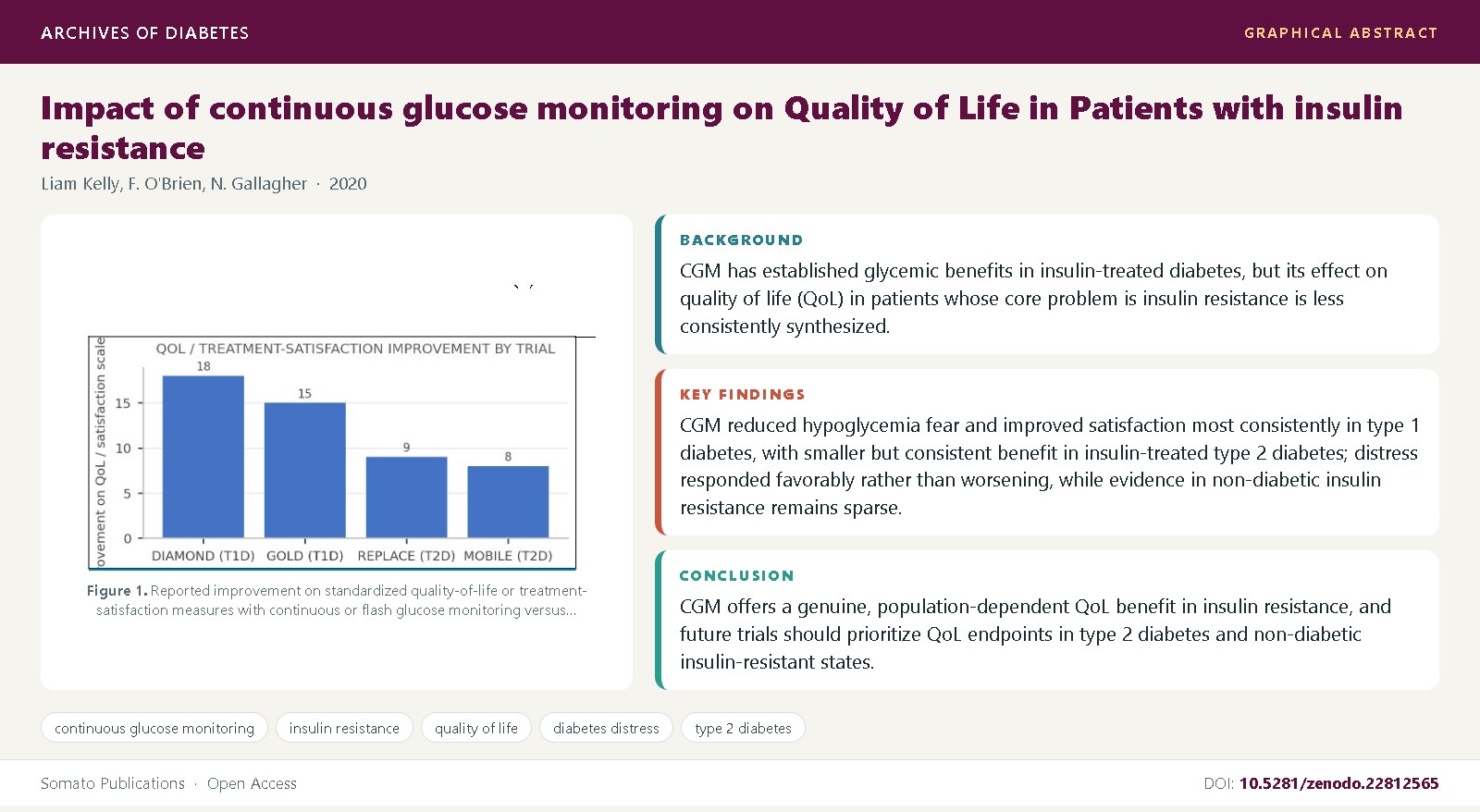
Background: CGM has established glycemic benefits in insulin-treated diabetes, but its effect on quality of life (QoL) in patients whose core problem is insulin resistance is less consistently synthesized.
Objective: To synthesize evidence on CGM and QoL, distress, and hypoglycemia fear in insulin-resistant and insulin-treated populations, using type 1 diabetes trials as a comparator.
Methods: We synthesized randomized trials, cohort studies, and reviews reporting validated QoL, distress, or satisfaction outcomes alongside CGM or flash monitoring.
Findings: CGM reduced hypoglycemia fear and improved satisfaction most consistently in type 1 diabetes, with smaller but consistent benefit in insulin-treated type 2 diabetes; distress responded favorably rather than worsening, while evidence in non-diabetic insulin resistance remains sparse.
Conclusions: CGM offers a genuine, population-dependent QoL benefit in insulin resistance, and future trials should prioritize QoL endpoints in type 2 diabetes and non-diabetic insulin-resistant states.
References
Reaven, G.M. (1988) Banting Lecture 1988: role of insulin resistance in human disease. Diabetes, 37(12): 1595-1607. DOI: 10.2337/diab.37.12.1595
DeFronzo, R.A. (1992) Insulin resistance: a multifaceted syndrome responsible for NIDDM, obesity, hypertension, dyslipidaemia and atherosclerosis. Netherlands Journal of Medicine, 50(5): 191-197.
DeFronzo, R.A., Tripathy, D. (2009) Skeletal muscle insulin resistance is the primary defect in type 2 diabetes. Diabetes Care, 32(Suppl 2): S157-S163. DOI: 10.2337/dc09-S302
Matthews, D.R., Hosker, J.P., Rudenski, A.S., Naylor, B.A., Treacher, D.F., Turner, R.C. (1985) Homeostasis model assessment: insulin resistance and beta-cell function from fasting plasma glucose and insulin concentrations in man. Diabetologia, 28(7): 412-419. DOI: 10.1007/BF00280883
Beck, R.W., Riddlesworth, T., Ruedy, K., Ahmann, A., Bergenstal, R., Haller, S., et al. (2017) Effect of continuous glucose monitoring on glycemic control in adults with type 1 diabetes using insulin injections: the DIAMOND randomized clinical trial. JAMA, 317(4): 371-378. DOI: 10.1001/jama.2016.19975
Lind, M., Polonsky, W., Hirsch, I.B., Heise, T., Bolinder, J., Dahlqvist, S., et al. (2017) Continuous glucose monitoring vs conventional therapy for glycemic control in adults with type 1 diabetes treated with multiple daily insulin injections: the GOLD randomized clinical trial. JAMA, 317(4): 379-387. DOI: 10.1001/jama.2016.19976
Haak, T., Hanaire, H., Ajjan, R., Hermanns, N., Riveline, J.P., Rayman, G. (2017) Flash glucose-sensing technology as a replacement for blood glucose monitoring for the management of insulin-treated type 2 diabetes: a multicenter, open-label randomized controlled trial. Diabetes Therapy, 8(1): 55-73. DOI: 10.1007/s13300-016-0223-6
Bolinder, J., Antuna, R., Geelhoed-Duijvestijn, P., Kroger, J., Weitgasser, R. (2016) Novel glucose-sensing technology and hypoglycaemia in type 1 diabetes: a multicentre, non-masked, randomised controlled trial. Lancet, 388(10057): 2254-2263. DOI: 10.1016/S0140-6736(16)31535-5
Martens, T., Beck, R.W., Bailey, R., Ruedy, K.J., Calhoun, P., Peters, A.L., et al. (2021) Effect of continuous glucose monitoring on glycemic control in patients with type 2 diabetes treated with basal insulin: a randomized clinical trial. JAMA, 325(22): 2262-2272. DOI:
1001/jama.2021.7444 10. Pratley, R.E., Kanapka, L.G., Rickels, M.R., Ahmann, A., Aleppo, G., Beck, R., et al. (2020) Effect of continuous glucose monitoring on hypoglycemia in older adults with type 1 diabetes: a randomized clinical trial. JAMA, 323(23): 2397-2406. DOI: 10.1001/jama.2020.6928
Feig, D.S., Donovan, L.E., Corcoy, R., Murphy, K.E., Amiel, S.A., Hunt, K.F., et al. (2017) Continuous glucose monitoring in pregnant women with type 1 diabetes (CONCEPTT): a multicentre international randomised controlled trial. Lancet, 390(10110): 2347-2359. DOI: 10.1016/S0140-6736(17)32400-5
Lin, R., Brown, F., James, S., Jones, J., Ekinci, E. (2021) Continuous glucose monitoring: a review of the evidence in type 1 and 2 diabetes mellitus. Diabetic Medicine, 38(5): e14528. DOI: 10.1111/dme.14528
Battelino, T., Danne, T., Bergenstal, R.M., Amiel, S.A., Beck, R., Biester, T., et al. (2019) Clinical targets for continuous glucose monitoring data interpretation: recommendations from the international consensus on time in range. Diabetes Care, 42(8): 1593-1603. DOI: 10.2337/dci19-0028
Danne, T., Nimri, R., Battelino, T., Bergenstal, R.M., Close, K.L., DeVries, J.H., et al. (2017) International consensus on use of continuous glucose monitoring. Diabetes Care, 40(12): 1631-1640. DOI: 10.2337/dc17-1600
Polonsky, W.H., Anderson, B.J., Lohrer, P.A., Welch, G., Jacobson, A.M., Aponte, J.E., et al. (1995) Assessment of diabetes-related distress. Diabetes Care, 18(6): 754-760. DOI: 10.2337/diacare.18.6.754
Rubin, R.R., Peyrot, M. (1999) Quality of life and diabetes. Diabetes/Metabolism Research and Reviews, 15(3): 205-218. DOI: 10.1002/(SICI)1520-7560(199905/06)15:3<205::AID-D MRR29>3.0.CO;2-O
Diabetes Control and Complications Trial Research Group (1993) The effect of intensive treatment of diabetes on the development and progression of long-term complications in insulin-dependent diabetes mellitus. New England Journal of Medicine, 329(14): 977-986. DOI: 10.1056/NEJM199309303291401
UK Prospective Diabetes Study (UKPDS) Group (1998) Intensive blood-glucose control with sulphonylureas or insulin compared with conventional treatment and risk of complications in patients with type 2 diabetes (UKPDS 33). Lancet, 352(9131): 837-853. DOI: 10.1016/S0140-6736(98)07019-6
Polonsky, W.H., Hessler, D., Ruedy, K.J., Beck, R.W. (2017) The impact of continuous glucose monitoring on markers of quality of life in adults with type 1 diabetes: further findings from the DIAMOND randomized clinical trial. Diabetes Care, 40(6): 736-741. DOI: 10.2337/dc17-0133
Deng, S., He, S., Guo, L. (2018) Effect of real-time continuous glucose monitoring on quality of life and glycemic control in adults with type 1 diabetes: a systematic review and meta-analysis. Endocrine, 60(1): 33-40. DOI: 10.1007/s12020-018-1544-0
Yoo, H.J., An, H.G., Park, S.Y., Ryu, O.H., Kim, H.Y., Seo, J.A., et al. (2008) Use of a real time continuous glucose monitoring system as a motivational device for poorly controlled type 2 diabetes. Diabetes Research and Clinical Practice, 82(1): 73-79. DOI: 10.1016/j.diabres.2008.06.015
Ehrhardt, N.M., Chellappa, M., Walker, M.S., Fonda, S.J., Vigersky, R.A. (2011) The effect of real-time continuous glucose monitoring on glycemic control in patients with type 2 diabetes mellitus. Journal of Diabetes Science and Technology, 5(3): 668-675. DOI: 10.1177/193229681100500320
Vigersky, R.A., Fonda, S.J., Chellappa, M., Walker, M.S., Ehrhardt, N.M. (2012) Short- and long-term effects of real-time continuous glucose monitoring in patients with type 2 diabetes. Diabetes Care, 35(1): 32-38. DOI: 10.2337/dc11-1438
Polonsky, W.H., Fisher, L., Earles, J., Dudl, R.J., Lees, J., Mullan, J., et al. (2005) Assessing psychosocial distress in diabetes: development of the diabetes distress scale. Diabetes Care, 28(3): 626-631. DOI: 10.2337/diacare.28.3.626
Fisher, L., Hessler, D., Glasgow, R.E., Arean, P.A., Masharani, U., Naranjo, D., et al. (2013) REDEEM: a pragmatic trial to reduce diabetes distress. Diabetes Care, 36(9): 2551-2558. DOI: 10.2337/dc12-2493
Barnard, L., Ferriday, D., Guenther, N., Strauss, B., Balen, A.H., Dye, L. (2007) Quality of life and psychological well being in polycystic ovary syndrome. Human Reproduction, 22(8): 2279-2286. DOI: 10.1093/humrep/dem108
Jones, G.L., Hall, J.M., Balen, A.H., Ledger, W.L. (2008) Health-related quality of life measurement in women with polycystic ovary syndrome: a systematic review. Human Reproduction Update, 14(1): 15-25. DOI: 10.1093/humupd/dmm030
Polonsky, W.H., Fisher, L., Hessler, D., Edelman, S.V. (2014) What is so tough about self-monitoring of blood glucose? Perceived obstacles among patients with type 2 diabetes. Diabetic Medicine, 31(1): 40-46. DOI: 10.1111/dme.12275
Snoek, F.J., Bremmer, M.A., Hermanns, N. (2015) Constructs of depression and distress in diabetes: time for an appraisal. Lancet Diabetes & Endocrinology, 3(6): 450-460. DOI: 10.1016/S2213-8587(15)00135-7
Rodbard, D. (2016) Continuous glucose monitoring: a review of successes, challenges, and opportunities. Diabetes Technology & Therapeutics, 18(Suppl 2): S3-S13. DOI: 10.1089/dia.2015.0417
Facchinetti, A. (2017) Continuous glucose monitoring sensors: past, present and future algorithmic challenges. Sensors, 17(10): 2361. DOI: 10.3390/s17102361
Cappon, G., Vettoretti, M., Sparacino, G., Facchinetti, A. (2019) Continuous glucose monitoring sensors for diabetes management: a review of technologies and applications. Diabetes & Metabolism Journal, 43(4): 383-397. DOI: 10.4093/dmj.2019.0121
Hirsch, I.B. (2009) Clinical review: realistic expectations and practical use of continuous glucose monitoring for the endocrinologist. Journal of Clinical Endocrinology & Metabolism, 94(7): 2232-2238. DOI: 10.1210/jc.2008-2625
Ida, S., Kaneko, R., Murata, K. (2019) Utility of real-time and retrospective continuous glucose monitoring in patients with type 2 diabetes mellitus: a meta-analysis of randomized controlled trials. Journal of Diabetes Research, 2019: 4684815. DOI: 10.1155/2019/4684815

Published
Issue
Section
License
Copyright (c) 2020 Liam Kelly, et al.

This work is licensed under a Creative Commons Attribution 4.0 International License.


