
Evaluation of HbA1c trend analysis as a Prognostic Tool in gestational diabetes
DOI:
https://doi.org/10.5281/zenodo.22812548Keywords:
HbA1c, gestational diabetes, prognostic marker, glycated haemoglobin, pregnancy outcomesAbstract
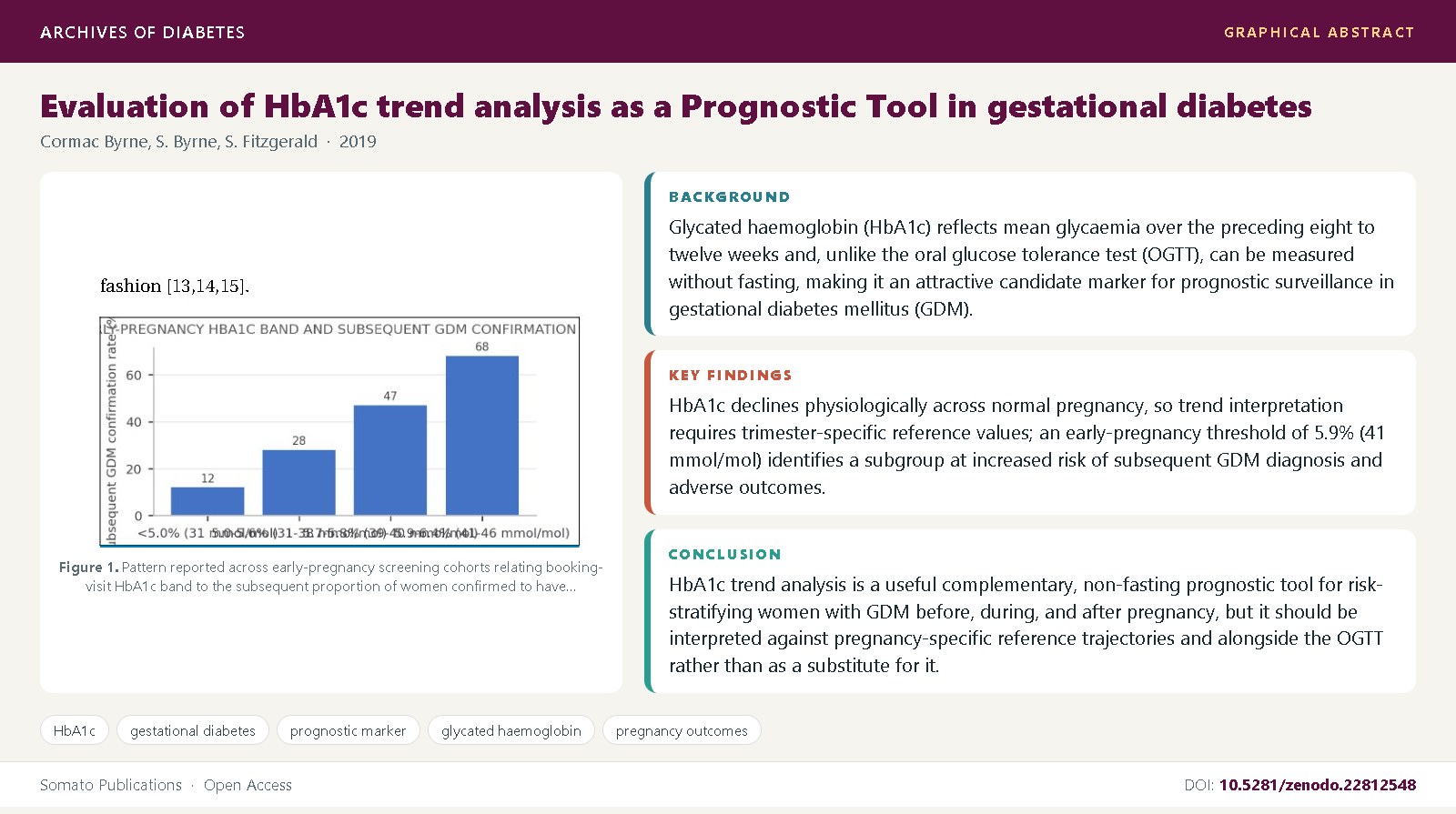
Background: Glycated haemoglobin (HbA1c) reflects mean glycaemia over the preceding eight to twelve weeks and, unlike the oral glucose tolerance test (OGTT), can be measured without fasting, making it an attractive candidate marker for prognostic surveillance in gestational diabetes mellitus (GDM).
Objective: This review evaluates the evidence for HbA1c, and particularly HbA1c trend across pregnancy, as a prognostic tool for maternal and neonatal outcomes in GDM, in comparison with the OGTT-based diagnostic standard.
Methods: We synthesized cohort studies, randomized treatment trials, and guideline documents addressing HbA1c reference intervals in pregnancy, early-pregnancy HbA1c screening thresholds, HbA1c trend and adverse pregnancy outcomes, and postpartum diabetes risk stratification.
Findings: HbA1c declines physiologically across normal pregnancy, so trend interpretation requires trimester-specific reference values; an early-pregnancy threshold of 5.9% (41 mmol/mol) identifies a subgroup at increased risk of subsequent GDM diagnosis and adverse outcomes; and antenatal glycaemic trajectory, including HbA1c, is associated with postpartum glucose intolerance and long-term type 2 diabetes risk.
Conclusions: HbA1c trend analysis is a useful complementary, non-fasting prognostic tool for risk-stratifying women with GDM before, during, and after pregnancy, but it should be interpreted against pregnancy-specific reference trajectories and alongside the OGTT rather than as a substitute for it.
References
O'Sullivan, J.B., Mahan, C.M. (1964) Criteria for the oral glucose tolerance test in pregnancy. Diabetes, 13: 278-285.
Metzger, B.E., Coustan, D.R. (1998) Summary and recommendations of the Fourth International Workshop-Conference on Gestational Diabetes Mellitus. The Organizing Committee. Diabetes Care, 21(Suppl 2): B161-B167.
HAPO Study Cooperative Research Group (2002) The Hyperglycemia and Adverse Pregnancy Outcome (HAPO) Study. International Journal of Gynaecology and Obstetrics, 78(1): 69-77. DOI: 10.1016/S0020-7292(02)00092-9
HAPO Study Cooperative Research Group (2008) Hyperglycemia and adverse pregnancy outcomes. New England Journal of Medicine, 358(19): 1991-2002. DOI: 10.1056/NEJMoa0707943
Metzger, B.E., Gabbe, S.G., Persson, B., Buchanan, T.A., Catalano, P.A., Damm, P., et al.; International Association of Diabetes and Pregnancy Study Groups Consensus Panel (2010) International association of diabetes and pregnancy study groups recommendations on the diagnosis and classification of hyperglycemia in pregnancy. Diabetes Care, 33(3): 676-682. DOI: 10.2337/dc09-1848
Coustan, D.R., Lowe, L.P., Metzger, B.E., Dyer, A.R.; International Association of Diabetes and Pregnancy Study Groups (2010) The Hyperglycemia and Adverse Pregnancy Outcome (HAPO) study: paving the way for new diagnostic criteria for gestational diabetes mellitus. American Journal of Obstetrics and Gynecology, 202(6): 654.e1-654.e6. DOI: 10.1016/j.ajog.2010.04.006
American Diabetes Association (2021) 14. Management of diabetes in pregnancy: Standards of Medical Care in Diabetes-2021. Diabetes Care, 44(Suppl 1): S200-S210. DOI: 10.2337/dc21-S014
Nielsen, L.R., Ekbom, P., Damm, P., Glumer, C., Frandsen, M.M., Jensen, D.M., Mathiesen, E.R. (2004) HbA1c levels are significantly lower in early and late pregnancy. Diabetes Care, 27(5): 1200-1201. DOI: 10.2337/diacare.27.5.1200
Mosca, A., Paleari, R., Dalfra, M.G., Di Cianni, G., Cuccuru, I., Pellegrini, G., et al. (2006) Reference intervals for hemoglobin A1c in pregnant women: data from an Italian multicenter study. Clinical Chemistry, 52(6): 1138-1143. DOI:
1373/clinchem.2005.064899 10. Hiramatsu, Y., Shimizu, I., Omori, Y., Nakabayashi, M.; JGA(HbA1c) Study Group (2012) Determination of reference intervals of glycated albumin and hemoglobin A1c in healthy pregnant Japanese women and the effect of gestation on the values. Endocrine Journal, 59(2): 145-151. DOI: 10.1507/endocrj.K10E-410
Radder, J.K., van Roosmalen, J. (2005) HbA1c in healthy, pregnant women. Netherlands Journal of Medicine, 63(7): 256-259.
Little, R.R., Rohlfing, C.L. (2013) The national glycohemoglobin standardization program: over 20 years of improving hemoglobin A1c measurement. Clinica Chimica Acta, 418: 63-71. DOI: 10.1016/j.cca.2012.12.026
Hughes, R.C., Moore, M.P., Gullam, J.E., Mohamed, K., Rowan, J. (2014) An early pregnancy HbA1c >=5.9% (41 mmol/mol) is optimal for detecting diabetes and identifies women at increased risk of adverse pregnancy outcomes. Diabetes Care, 37(11): 2953-2959. DOI: 10.2337/dc14-1312
Rowan, J.A., Budden, A., Ivanova, V., Hughes, R.C., Sadler, L.C. (2016) Women with an HbA1c of 41-49 mmol/mol (5.9-6.6%): a higher-risk subgroup that may benefit from early pregnancy intervention. Diabetic Medicine, 33(1): 25-31. DOI: 10.1111/dme.12812
Ho, Y.R., Wang, P., Lu, M.C., Tseng, S.T., Yang, C.P., Yan, Y.H. (2017) Associations of mid-pregnancy HbA1c with gestational diabetes and risk of adverse pregnancy outcomes in high-risk Taiwanese women. PLoS One, 12(5): e0177563. DOI: 10.1371/journal.pone.0177563
Catalano, P.M., McIntyre, H.D., Cruickshank, J.K., McCance, D.R., Dyer, A.R., Metzger, B.E., et al.; HAPO Study Cooperative Research Group (2012) The Hyperglycemia and Adverse Pregnancy Outcome study: associations of GDM and obesity with pregnancy outcomes. Diabetes Care, 35(4): 780-786. DOI: 10.2337/dc11-1790
Scholtens, D.M., Kuang, A., Lowe, L.P., Hamilton, J., Lawrence, J.M., Lebenthal, Y., et al.; HAPO Follow-up Study Cooperative Research Group (2019) Hyperglycemia and Adverse Pregnancy Outcome Follow-up Study (HAPO FUS): maternal glycemia and childhood glucose metabolism. Diabetes Care, 42(3): 381-392. DOI: 10.2337/dc18-2021
Crowther, C.A., Hiller, J.E., Moss, J.R., McPhee, A.J., Jeffries, W.S., Robinson, J.S.; Australian Carbohydrate Intolerance Study in Pregnant Women (ACHOIS) Trial Group (2005) Effect of treatment of gestational diabetes mellitus on pregnancy outcomes. New England Journal of Medicine, 352(24): 2477-2486. DOI: 10.1056/NEJMoa042973
Landon, M.B., Spong, C.Y., Thom, E., Carpenter, M.W., Ramin, S.M., Casey, B., et al.; Eunice Kennedy Shriver National Institute of Child Health and Human Development Maternal-Fetal Medicine Units Network (2009) A multicenter, randomized trial of treatment for mild gestational diabetes. New England Journal of Medicine, 361(14): 1339-1348. DOI: 10.1056/NEJMoa0902430
Langer, O., Yogev, Y., Most, O., Xenakis, E.M. (2005) Gestational diabetes: the consequences of not treating. American Journal of Obstetrics and Gynecology, 192(4): 989-997. DOI: 10.1016/j.ajog.2004.11.039
Ye, W., Luo, C., Huang, J., Li, C., Liu, Z., Liu, F. (2022) Gestational diabetes mellitus and adverse pregnancy outcomes: systematic review and meta-analysis. BMJ, 377: e067946. DOI: 10.1136/bmj-2021-067946
Zhu, W.W., Yang, H.X., Wei, Y.M., Yan, J., Wang, Z.L., Li, X.L., et al. (2013) Evaluation of the value of fasting plasma glucose in the first prenatal visit to diagnose gestational diabetes mellitus in China. Diabetes Care, 36(3): 586-590. DOI: 10.2337/dc12-1157
Sacks, D.A., Chen, W., Wolde-Tsadik, G., Buchanan, T.A. (2006) Fasting plasma glucose test at the first prenatal visit as a screen for gestational diabetes. Obstetrics and Gynecology, 108(3 Pt 1): 613-619. DOI: 10.1097/01.AOG.0000232512.46869.14
World Health Organization (2013) Diagnostic Criteria and Classification of Hyperglycaemia First Detected in Pregnancy. WHO/NMH/MND/13.2. World Health Organization, Geneva.
American College of Obstetricians and Gynecologists (2018) ACOG Practice Bulletin No. 190: Gestational Diabetes Mellitus. Obstetrics and Gynecology, 131(2): e49-e64. DOI: 10.1097/AOG.0000000000002501
Bellamy, L., Casas, J.P., Hingorani, A.D., Williams, D. (2009) Type 2 diabetes mellitus after gestational diabetes: a systematic review and meta-analysis. Lancet, 373(9677): 1773-1781. DOI: 10.1016/S0140-6736(09)60731-5
Kim, C., Newton, K.M., Knopp, R.H. (2002) Gestational diabetes and the incidence of type 2 diabetes: a systematic review. Diabetes Care, 25(10): 1862-1868. DOI: 10.2337/diacare.25.10.1862
Katon, J.G., Reiber, G.E., Williams, M.A., Yanez, D., Miller, E. (2012) Hemoglobin A1c and postpartum abnormal glucose tolerance among women with gestational diabetes mellitus. Obstetrics and Gynecology, 119(3): 566-574. DOI: 10.1097/AOG.0b013e3182475ac0
Retnakaran, R., Qi, Y., Sermer, M., Connelly, P.W., Hanley, A.J., Zinman, B. (2008) Glucose intolerance in pregnancy and future risk of pre-diabetes or diabetes. Diabetes Care, 31(10): 2026-2031. DOI: 10.2337/dc08-0972
Agarwal, M.M., Hughes, P.F., Punnose, J., Ezimokhai, M., Thomas, L. (2001) Fasting plasma glucose as a screening test for gestational diabetes mellitus in an Arab population. Diabetic Medicine, 18(2): 133-138. DOI: 10.1046/j.1464-5491.2001.00443.x
Suhonen, L., Hiilesmaa, V., Teramo, K. (2000) Glycaemic control during early pregnancy and fetal malformations in women with type I diabetes mellitus. Diabetologia, 43(1): 79-82. DOI: 10.1007/s001250050010
Hedderson, M.M., Gunderson, E.P., Ferrara, A. (2010) Gestational weight gain and risk of gestational diabetes mellitus. Obstetrics and Gynecology, 115(3): 597-604. DOI: 10.1097/AOG.0b013e3181cfce4f
Cheng, Y.W., Chung, J.H., Kurbisch-Block, I., Inturrisi, M., Shafer, S., Caughey, A.B. (2011) Gestational weight gain and gestational diabetes mellitus: perinatal outcomes. Obstetrics and Gynecology, 117(5): 1105-1111. DOI: 10.1097/AOG.0b013e318213f1de

Published
Issue
Section
License
Copyright (c) 2019 Cormac Byrne, et al.

This work is licensed under a Creative Commons Attribution 4.0 International License.


