
A Retrospective Cohort Study of enzyme immobilization techniques in industrial fermentation systems with low bioreactor yield
DOI:
https://doi.org/10.5281/zenodo.22812460Keywords:
enzyme immobilization, industrial fermentation, bioreactor yield, biocatalyst stability, cross-linked enzyme aggregatesAbstract
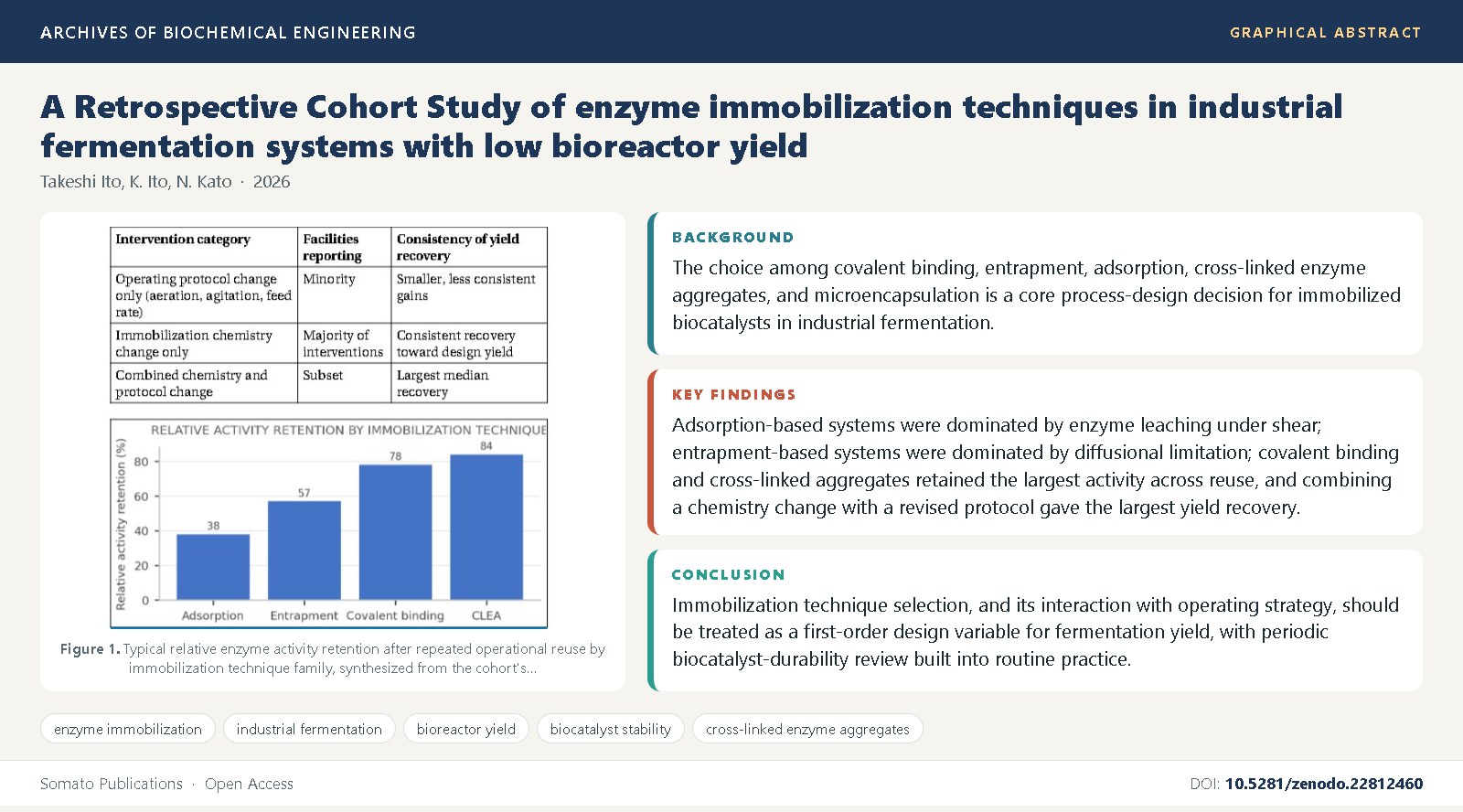
Background: The choice among covalent binding, entrapment, adsorption, cross-linked enzyme aggregates, and microencapsulation is a core process-design decision for immobilized biocatalysts in industrial fermentation.
Objective: This retrospective cohort study examined documented fermentation operations to determine which immobilization technique choices were most often associated with low bioreactor yield, which failure mechanisms recurred, and which interventions restored yield.
Methods: Eligible records from the biocatalysis and bioprocess-engineering literature were classified by immobilization technique family and coded for cause of yield shortfall and reported corrective intervention.
Results: Adsorption-based systems were dominated by enzyme leaching under shear; entrapment-based systems were dominated by diffusional limitation; covalent binding and cross-linked aggregates retained the largest activity across reuse, and combining a chemistry change with a revised protocol gave the largest yield recovery.
Conclusions: Immobilization technique selection, and its interaction with operating strategy, should be treated as a first-order design variable for fermentation yield, with periodic biocatalyst-durability review built into routine practice.
References
Sheldon, R.A. (2007) Enzyme immobilization: the quest for optimum performance. Advanced Synthesis & Catalysis, 349(8-9): 1289-1307.
Sheldon, R.A., van Pelt, S. (2013) Enzyme immobilisation in biocatalysis: why, what and how. Chemical Society Reviews, 42(15): 6223-6235.
Cao, L., van Langen, L., Sheldon, R.A. (2003) Immobilised enzymes: carrier-bound or carrier-free? Current Opinion in Biotechnology, 14(4): 387-394.
Mateo, C., Palomo, J.M., Fernandez-Lorente, G., Guisan, J.M., Fernandez-Lafuente, R. (2007) Improvement of enzyme activity, stability and selectivity via immobilization techniques. Enzyme and Microbial Technology, 40(6): 1451-1463.
Garcia-Ochoa, F., Gomez, E. (2009) Bioreactor scale-up and oxygen transfer rate in microbial processes: an overview. Biotechnology Advances, 27(2): 153-176.
Junker, B.H. (2004) Scale-up methodologies for Escherichia coli and yeast fermentation processes. Journal of Bioscience and Bioengineering, 97(6): 347-364.
Datta, S., Christena, L.R., Rajaram, Y.R. (2013) Enzyme immobilization: an overview on techniques and support materials. 3 Biotech, 3(1): 1-9.
Homaei, A.A., Sariri, R., Vianello, F., Stevanato, R. (2013) Enzyme immobilization: an update. Journal of Chemical Biology, 6(4): 185-205.
Brady, D., Jordaan, J. (2009) Advances in enzyme immobilisation. Biotechnology Letters, 31(11): 1639-1650.
Mohamad, N.R., Marzuki, N.H.C., Buang, N.A., Huyop, F., Wahab, R.A. (2015) An overview of technologies for immobilization of enzymes and surface analysis techniques for immobilized enzymes. Biotechnology & Biotechnological Equipment, 29(2): 205-220.
Rodrigues, R.C., Ortiz, C., Berenguer-Murcia, A., Torres, R., Fernandez-Lafuente, R. (2013) Modifying enzyme activity and selectivity by immobilization. Chemical Society Reviews, 42(15): 6290-6307.
Zdarta, J., Meyer, A.S., Jesionowski, T., Pinelo, M. (2018) A general overview of support materials for enzyme immobilization: characteristics, properties, practical utility. Catalysts, 8(2): 92.
Sirisha, V.L., Jain, A., Jain, A. (2016) Enzyme immobilization: an overview on methods, support material, and applications of immobilized enzymes. Advances in Food and Nutrition Research, 79: 179-211.
Liese, A., Hilterhaus, L. (2013) Evaluation of immobilized enzymes for industrial applications. Chemical Society Reviews, 42(15): 6236-6249.
Tischer, W., Wedekind, F. (1999) Immobilized enzymes: methods and applications. Topics in Current Chemistry, 200: 95-126.
Hanefeld, U., Gardossi, L., Magner, E. (2009) Understanding enzyme immobilisation. Chemical Society Reviews, 38(2): 453-468.
Jesionowski, T., Zdarta, J., Krajewska, B. (2014) Enzyme immobilization by adsorption: a review. Adsorption, 20(5-6): 801-821.
DiCosimo, R., McAuliffe, J., Poulose, A.J., Bohlmann, G. (2013) Industrial use of immobilized enzymes. Chemical Society Reviews, 42(15): 6437-6474.
Zhang, D.H., Yuwen, L.X., Peng, L.J. (2013) Parameters affecting the performance of immobilized enzyme. Journal of Chemistry, 2013: 946248.
Cantone, S., Ferrario, V., Corici, L., Ebert, C., Fattor, D., Spizzo, P., Gardossi, L. (2013) Efficient immobilisation of industrial biocatalysts: criteria and constraints for the selection of organic polymeric carriers and immobilisation methods. Chemical Society Reviews, 42(15): 6262-6276.
Krajewska, B. (2004) Application of chitin- and chitosan-based materials for enzyme immobilizations: a review. Enzyme and Microbial Technology, 35(2-3): 126-139.
Illanes, A., Cauerhff, A., Wilson, L., Castro, G.R. (2012) Recent trends in biocatalysis engineering. Bioresource Technology, 115: 48-57.
Bilal, M., Iqbal, H.M.N. (2019) Naturally-derived biopolymers: potential platforms for enzyme immobilization. International Journal of Biological Macromolecules, 130: 462-482.
Fernandez-Lafuente, R. (2009) Stabilization of multimeric enzymes: strategies to prevent subunit dissociation. Enzyme and Microbial Technology, 45(6-7): 405-418.
Sheldon, R.A. (2011) Cross-linked enzyme aggregates as industrial biocatalysts. Organic Process Research & Development, 15(1): 213-223.
Garcia-Galan, C., Berenguer-Murcia, A., Fernandez-Lafuente, R., Rodrigues, R.C. (2011) Potential of different enzyme immobilization strategies to improve enzyme performance. Advanced Synthesis & Catalysis, 353(16): 2885-2904.
Barbosa, O., Ortiz, C., Berenguer-Murcia, A., Torres, R., Rodrigues, R.C., Fernandez-Lafuente, R. (2014) Glutaraldehyde in bio-catalysts design: a useful crosslinker and a versatile tool in enzyme immobilization. RSC Advances, 4(4): 1583-1600.
Sheldon, R.A., Woodley, J.M. (2018) Role of biocatalysis in sustainable chemistry. Chemical Reviews, 118(2): 801-838.
Basso, A., Serban, S. (2019) Industrial applications of immobilized enzymes-a review. Molecular Catalysis, 479: 110607.
Singh, R.K., Tiwari, M.K., Singh, R., Lee, J.K. (2013) From protein engineering to immobilization: promising strategies for the upgrade of industrial enzymes. International Journal of Molecular Sciences, 14(1): 1232-1277.
Cao, L. (2005) Immobilised enzymes: science or art? Current Opinion in Chemical Biology, 9(2): 217-226.
Klibanov, A.M. (1983) Immobilized enzymes and cells as practical catalysts. Science, 219(4585): 722-727.
Bornscheuer, U.T. (2003) Immobilizing enzymes: how to create more suitable biocatalysts. Angewandte Chemie International Edition, 42(29): 3336-3337.
Wahab, R.A., Elias, N., Abdullah, F., Ghoshal, S.K. (2020) On the taught new tricks of enzymes immobilization: an all-inclusive review. Reactive and Functional Polymers, 152: 104613.
Nguyen, H.H., Kim, M. (2017) An overview of techniques in enzyme immobilization. Applied Science and Convergence Technology, 26(6): 157-163.
Spahn, C., Minteer, S.D. (2008) Enzyme immobilization in biotechnology. Recent Patents on Engineering, 2(3): 195-200.

Published
Issue
Section
License
Copyright (c) 2026 Takeshi Ito, et al.

This work is licensed under a Creative Commons Attribution 4.0 International License.


