
protein engineering in the Management of biofuel production inefficiency among industrial fermentation systems
DOI:
https://doi.org/10.5281/zenodo.22812385Keywords:
protein engineering, biofuel production, industrial fermentation, directed evolution, consolidated bioprocessingAbstract
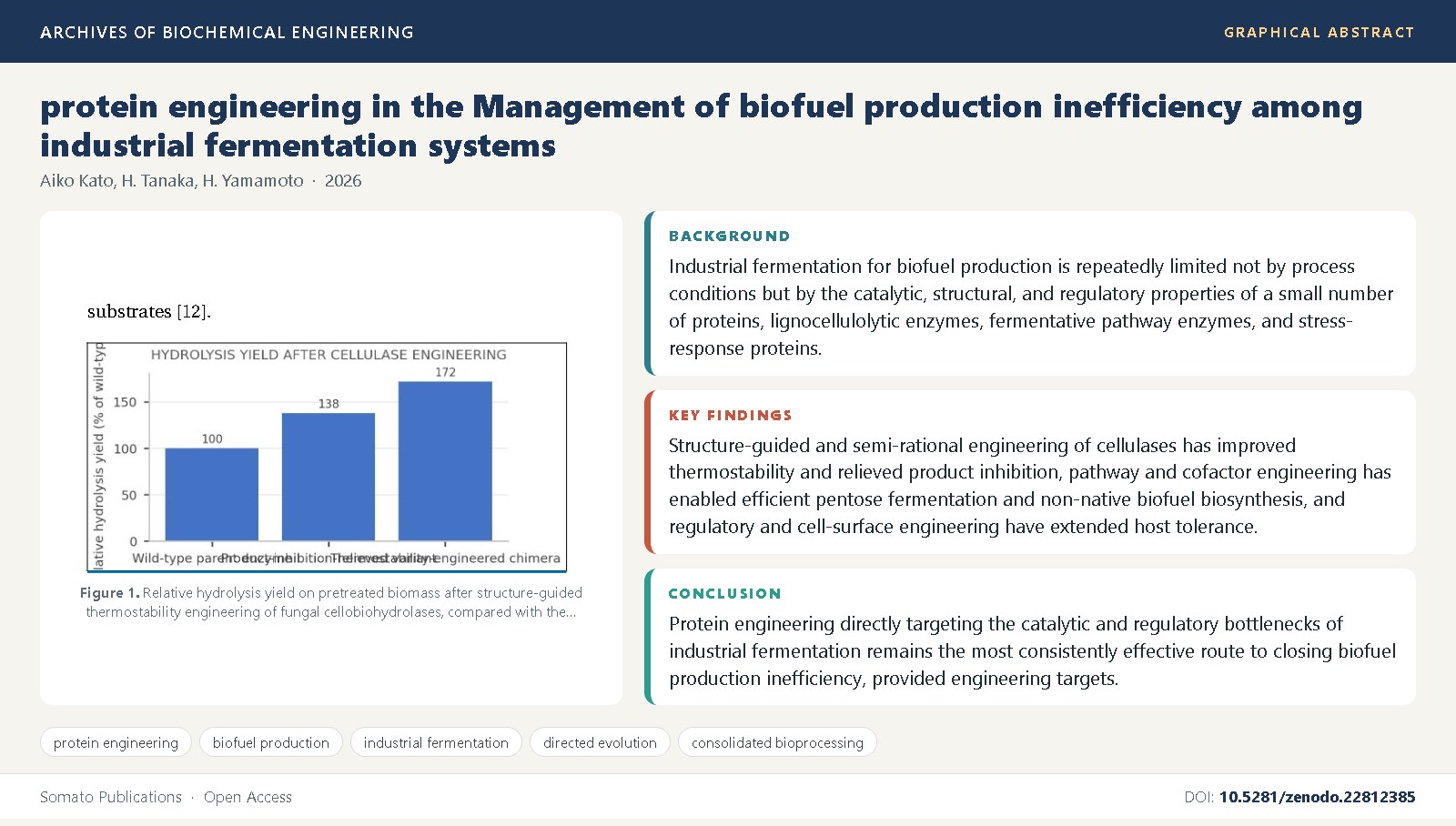
Background: Industrial fermentation for biofuel production is repeatedly limited not by process conditions but by the catalytic, structural, and regulatory properties of a small number of proteins, lignocellulolytic enzymes, fermentative pathway enzymes, and stress-response proteins, that set the ceiling on hydrolysis yield, pathway flux, and host tolerance [3,4].
Objective: This review synthesizes how protein engineering, by rational design, directed evolution, and semi-rational methods, has been used to resolve specific inefficiencies across industrial fermentation systems for biofuel production.
Methods: We synthesized peer-reviewed studies on cellulolytic enzyme engineering, pentose and biofuel pathway engineering, fermentation stress and inhibitor tolerance engineering, and consolidated bioprocessing strain design.
Findings: Structure-guided and semi-rational engineering of cellulases has improved thermostability and relieved product inhibition [7,9], pathway and cofactor engineering has enabled efficient pentose fermentation and non-native biofuel biosynthesis [15,16], and regulatory and cell-surface engineering have extended host tolerance and enabled consolidated bioprocessing [21,25], though gains measured at laboratory scale are not always fully retained under industrial process conditions [29,32].
Conclusions: Protein engineering directly targeting the catalytic and regulatory bottlenecks of industrial fermentation remains the most consistently effective route to closing biofuel production inefficiency, provided engineering targets and screening conditions are chosen to approximate the industrial environment from the outset [32,2].
References
Arnold, F.H. (1998) Design by directed evolution. Accounts of Chemical Research, 31(3): 125-131.
Bommarius, A.S., Blum, J.K., Abrahamson, M.J. (2011) Status of protein engineering for biocatalysts: how to design an industrially useful biocatalyst. Current Opinion in Chemical Biology, 15(2): 194-200.
Himmel, M.E., Ding, S.Y., Johnson, D.K., Adney, W.S., Nimlos, M.R., Brady, J.W., et al. (2007) Biomass recalcitrance: engineering plants and enzymes for biofuels production. Science, 315(5813): 804-807.
Zaldivar, J., Nielsen, J., Olsson, L. (2001) Fuel ethanol production from lignocellulose: a challenge for metabolic engineering and process integration. Applied Microbiology and Biotechnology, 56(1-2): 17-34.
Zhang, Y.H., Lynd, L.R. (2004) Toward an aggregated understanding of enzymatic hydrolysis of cellulose: noncomplexed cellulase systems. Biotechnology and Bioengineering, 88(7): 797-824.
Wilson, D.B. (2009) Cellulases and biofuels. Current Opinion in Biotechnology, 20(3): 295-299.
Heinzelman, P., Snow, C.D., Wu, I., Nguyen, C., Villalobos, A., Govindarajan, S., et al. (2009) A family of thermostable fungal cellulases created by structure-guided recombination. Proceedings of the National Academy of Sciences, 106(14): 5610-5615.
Voutilainen, S.P., Puranen, T., Siika-Aho, M., Lappalainen, A., Alapuranen, M., Kallio, J., et al. (2010) Cloning, expression, and characterization of novel thermostable family 7 cellobiohydrolases. Biotechnology and Bioengineering, 105(5): 923-931.
Zhang, Y.H., Himmel, M.E., Mielenz, J.R. (2006) Outlook for cellulase improvement: screening and selection strategies. Biotechnology Advances, 24(5): 452-481.
Cherry, J.R., Fidantsef, A.L. (2003) Directed evolution of industrial enzymes: an update. Current Opinion in Biotechnology, 14(4): 438-443.
Anbar, M., Bayer, E.A. (2012) Approaches for improving thermostability characteristics in cellulases. Methods in Enzymology, 510: 261-271.
Payne, C.M., Knott, B.C., Mayes, H.B., Hansson, H., Himmel, M.E., Sandgren, M., et al. (2015) Fungal cellulases. Chemical Reviews, 115(3): 1308-1448.
Jeffries, T.W., Jin, Y.S. (2004) Metabolic engineering for improved fermentation of pentoses by yeasts. Applied Microbiology and Biotechnology, 63(5): 495-509.
Ho, N.W., Chen, Z., Brainard, A.P. (1998) Genetically engineered Saccharomyces yeast capable of effective cofermentation of glucose and xylose. Applied and Environmental Microbiology, 64(5): 1852-1859.
Kuyper, M., Hartog, M.M., Toirkens, M.J., Almering, M.J., Winkler, A.A., van Dijken, J.P., et al. (2005) Metabolic engineering of a xylose-isomerase-expressing Saccharomyces cerevisiae strain for rapid anaerobic xylose fermentation. FEMS Yeast Research, 5(4-5): 399-409.
Atsumi, S., Hanai, T., Liao, J.C. (2008) Non-fermentative pathways for synthesis of branched-chain higher alcohols as biofuels. Nature, 451(7174): 86-89.
Bastian, S., Liu, X., Meyerowitz, J.T., Snow, C.D., Chen, M.M., Arnold, F.H. (2011) Engineered ketol-acid reductoisomerase and alcohol dehydrogenase enable anaerobic 2-methylpropan-1-ol production at theoretical yield in Escherichia coli. Metabolic Engineering, 13(3): 345-352.
Peralta-Yahya, P.P., Zhang, F., del Cardayre, S.B., Keasling, J.D. (2012) Microbial engineering for the production of advanced biofuels. Nature, 488(7411): 320-328.
Liu, Z.L. (2011) Molecular mechanisms of yeast tolerance and in situ detoxification of lignocellulose hydrolysates. Applied Microbiology and Biotechnology, 90(3): 809-825.
Almeida, J.R., Modig, T., Petersson, A., Hahn-Hagerdal, B., Liden, G., Gorwa-Grauslund, M.F. (2007) Increased tolerance and conversion of inhibitors in lignocellulosic hydrolysates by Saccharomyces cerevisiae. Journal of Chemical Technology and Biotechnology, 82(4): 340-349.
Alper, H., Moxley, J., Nevoigt, E., Fink, G.R., Stephanopoulos, G. (2006) Engineering yeast transcription machinery for improved ethanol tolerance and production. Science, 314(5805): 1565-1568.
Stephanopoulos, G. (2007) Challenges in engineering microbes for biofuels production. Science, 315(5813): 801-804.
Lynd, L.R., Weimer, P.J., van Zyl, W.H., Pretorius, I.S. (2002) Microbial cellulose utilization: fundamentals and biotechnology. Microbiology and Molecular Biology Reviews, 66(3): 506-577.
van Zyl, W.H., Lynd, L.R., den Haan, R., McBride, J.E. (2007) Consolidated bioprocessing for bioethanol production using Saccharomyces cerevisiae. Advances in Biochemical Engineering/Biotechnology, 108: 205-235.
Hasunuma, T., Kondo, A. (2012) Development of yeast cell factories for consolidated bioprocessing of lignocellulose to bioethanol through cell surface engineering. Biotechnology Advances, 30(6): 1207-1218.
Chica, R.A., Doucet, N., Pelletier, J.N. (2005) Semi-rational approaches to engineering enzyme activity: combining the benefits of directed evolution and rational design. Current Opinion in Biotechnology, 16(4): 378-384.
Turner, N.J. (2009) Directed evolution drives the next generation of biocatalysts. Nature Chemical Biology, 5(8): 567-573.
Bornscheuer, U.T., Huisman, G.W., Kazlauskas, R.J., Lutz, S., Moore, J.C., Robins, K. (2012) Engineering the third wave of biocatalysis. Nature, 485(7397): 185-194.
Mosier, N., Wyman, C., Dale, B., Elander, R., Lee, Y.Y., Holtzapple, M., et al. (2005) Features of promising technologies for pretreatment of lignocellulosic biomass. Bioresource Technology, 96(6): 673-686.
Blanch, H.W., Simmons, B.A., Klein-Marcuschamer, D. (2011) Biomass deconstruction to sugars. Biotechnology Journal, 6(9): 1086-1102.
Sun, Y., Cheng, J. (2002) Hydrolysis of lignocellulosic materials for ethanol production: a review. Bioresource Technology, 83(1): 1-11.
Banerjee, G., Scott-Craig, J.S., Walton, J.D. (2010) Improving enzymes for biomass conversion: a basic research perspective. BioEnergy Research, 3(1): 82-92.
Steen, E.J., Kang, Y., Bokinsky, G., Hu, Z., Schirmer, A., McClure, A., et al. (2010) Microbial production of fatty-acid-derived fuels and chemicals from plant biomass. Nature, 463(7280): 559-562.
Dashtban, M., Schraft, H., Qin, W. (2009) Fungal bioconversion of lignocellulosic residues; opportunities & perspectives. International Journal of Biological Sciences, 5(6): 578-595.

Published
Issue
Section
License
Copyright (c) 2026 Aiko Kato, et al.

This work is licensed under a Creative Commons Attribution 4.0 International License.


