
Prevalence and Risk Factors of low bioreactor yield in pilot-scale bioreactors
DOI:
https://doi.org/10.5281/zenodo.22812480Keywords:
bioreactor scale-up, pilot-scale fermentation, oxygen transfer, mixing time, yield lossAbstract
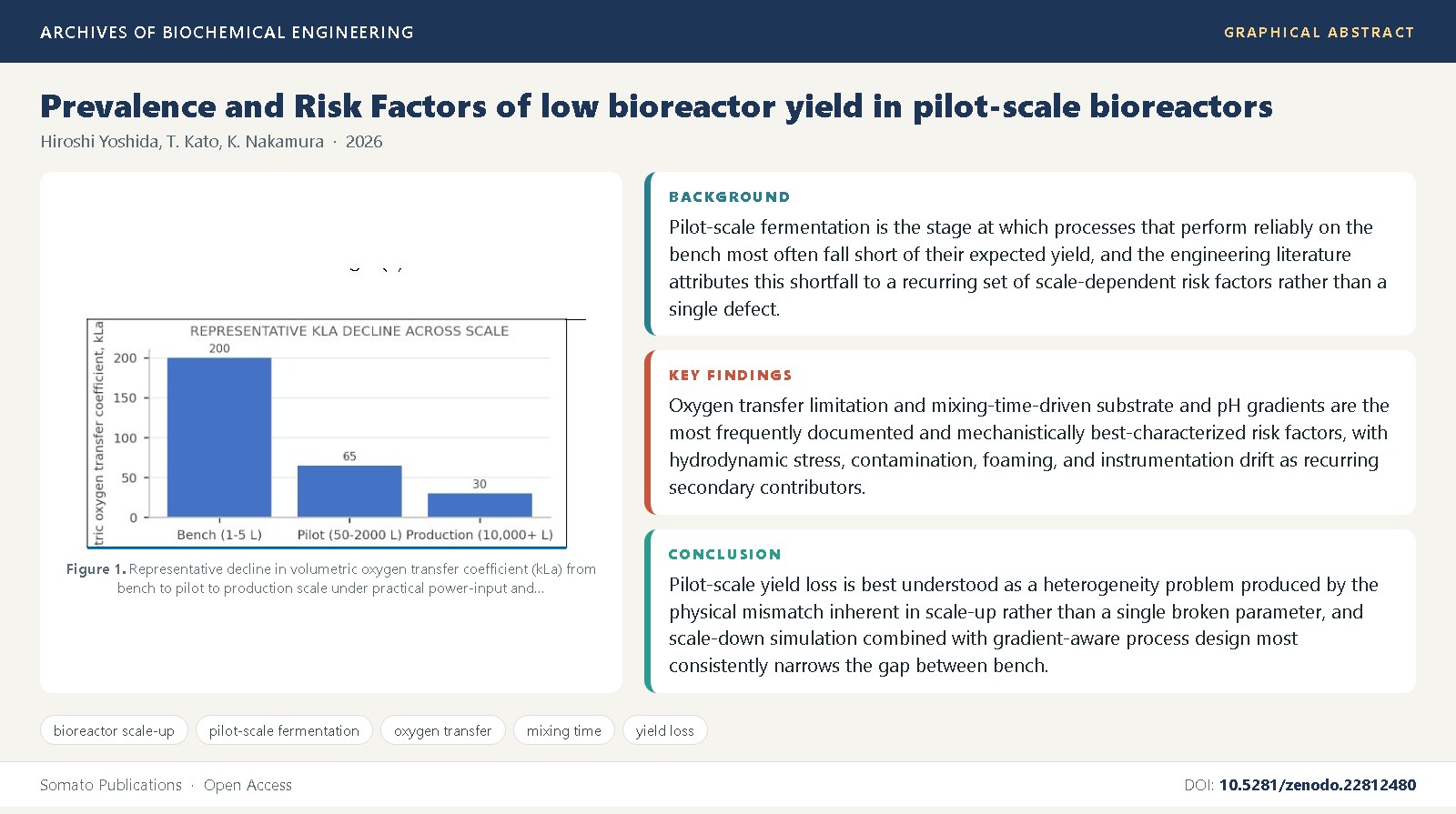
Background: Pilot-scale fermentation is the stage at which processes that perform reliably on the bench most often fall short of their expected yield, and the engineering literature attributes this shortfall to a recurring set of scale-dependent risk factors rather than a single defect [3,1].
Objective: This review synthesizes the prevalence and mechanisms of the principal risk factors reported for low yield in pilot-scale bioreactors and summarizes the mitigation strategies most consistently supported by the scale-up and scale-down literature.
Methods: We synthesized peer-reviewed bioprocess engineering reviews, scale-down simulation studies, and mechanistic mass-transfer and mixing studies addressing stirred-tank bioreactors in the approximately 20-2000 L pilot-scale range.
Findings: Oxygen transfer limitation and mixing-time-driven substrate and pH gradients are the most frequently documented and mechanistically best-characterized risk factors [3,12,20], with hydrodynamic stress, contamination, foaming, and instrumentation drift as recurring secondary contributors [17,25,26].
Conclusions: Pilot-scale yield loss is best understood as a heterogeneity problem produced by the physical mismatch inherent in scale-up rather than a single broken parameter, and scale-down simulation combined with gradient-aware process design most consistently narrows the gap between bench and pilot performance [29,34].
References
Junker, B.H. (2004) Scale-up methodologies for Escherichia coli and yeast fermentation processes. Journal of Bioscience and Bioengineering, 97(6): 347-364.
Schmidt, F.R. (2005) Optimization and scale up of industrial fermentation processes. Applied Microbiology and Biotechnology, 68(4): 425-435.
Garcia-Ochoa, F., Gomez, E. (2009) Bioreactor scale-up and oxygen transfer rate in microbial processes: an overview. Biotechnology Advances, 27(2): 153-176.
Marques, M.P.C., Cabral, J.M.S., Fernandes, P. (2010) Bioprocess scale-up: quest for the parameters to be used as criterion to move from microreactors to lab-scale. Journal of Chemical Technology and Biotechnology, 85(9): 1184-1198.
Nienow, A.W. (1998) Hydrodynamics of stirred bioreactors. Applied Mechanics Reviews, 51(1): 3-32.
van't Riet, K. (1979) Review of measuring methods and results in nonviscous gas-liquid mass transfer in stirred vessels. Industrial and Engineering Chemistry Process Design and Development, 18(3): 357-364.
Lara, A.R., Galindo, E., Ramirez, O.T., Palomares, L.A. (2006) Living with heterogeneities in bioreactors: understanding the effects of environmental gradients on cells. Molecular Biotechnology, 34(3): 355-381.
Enfors, S.O., Jahic, M., Rozkov, A., Xu, B., Hecker, M., Jurgen, B., et al. (2001) Physiological responses to mixing in large scale bioreactors. Journal of Biotechnology, 85(2): 175-185.
Takors, R. (2012) Scale-up of microbial processes: impacts, tools and open questions. Journal of Biotechnology, 160(1-2): 3-9.
Crater, J.S., Lievense, J.C. (2018) Scale-up of industrial microbial processes. FEMS Microbiology Letters, 365(13): fny138.
George, S., Larsson, G., Enfors, S.O. (1993) A scale-down two-compartment reactor with controlled substrate oscillations: metabolic response of Saccharomyces cerevisiae. Bioprocess Engineering, 9(6): 249-257.
Bylund, F., Collet, E., Enfors, S.O., Larsson, G. (1998) Substrate gradient formation in the large-scale bioreactor lowers cell yield and increases by-product formation. Bioprocess Engineering, 18(3): 171-180.
Amanullah, A., McFarlane, C.M., Emery, A.N., Nienow, A.W. (2001) Scale-down model to simulate spatial pH variations in large-scale bioreactors. Biotechnology and Bioengineering, 73(5): 390-399.
Kass, F., Junne, S., Neubauer, P., Wiechert, W., Oldiges, M. (2014) Process inhomogeneity leads to rapid side product turnover in cultivation of Corynebacterium glutamicum. Microbial Cell Factories, 13: 6.
Oosterhuis, N.M.G., Kossen, N.W.F. (1984) Dissolved oxygen concentration profiles in a production-scale bioreactor. Biotechnology and Bioengineering, 26(5): 546-550.
Manfredini, R., Cavallera, V., Marini, L., Donati, G. (1983) Mixing and oxygen transfer in conventional stirred fermenters. Biotechnology and Bioengineering, 25(12): 3115-3131.
Chisti, Y. (2000) Animal-cell damage in sparged bioreactors. Trends in Biotechnology, 18(10): 420-432.
Chisti, Y. (2001) Hydrodynamic damage to animal cells. Critical Reviews in Biotechnology, 21(2): 67-110.
Garcia-Ochoa, F., Gomez, E., Santos, V.E., Merchuk, J.C. (2010) Oxygen uptake rate in microbial processes: an overview. Biochemical Engineering Journal, 49(3): 289-307.
Islam, R.S., Tisi, D., Levy, M.S., Lye, G.J. (2008) Scale-up of Escherichia coli growth and recombinant protein expression conditions from microwell to laboratory and pilot scale based on matched kLa. Biotechnology and Bioengineering, 99(5): 1128-1139.
Humphrey, A. (1998) Shake flask to fermentor: what have we learned? Biotechnology Progress, 14(1): 3-7.
Xu, B., Jahic, M., Enfors, S.O. (1999) Glucose overflow metabolism and mixing-limited fermentation of Escherichia coli. Biotechnology and Bioengineering, 63(4): 442-449.
Neubauer, P., Haggstrom, L., Enfors, S.O. (1995) Influence of substrate oscillations on acetate formation and growth yield in Escherichia coli glucose limited fed-batch cultivations. Biotechnology and Bioengineering, 47(2): 139-146.
Langheinrich, C., Nienow, A.W. (1999) Control of pH in large-scale, free suspension animal cell bioreactors: alkali addition and pH excursions. Biotechnology and Bioengineering, 66(3): 171-179.
Sandle, T. (2014) Contamination control and bioreactor monitoring: assessing risk factors in cell culture and microbial fermentation processes. Journal of Validation Technology, 20(3): 1-10.
Junker, B.H. (2007) Foam and its mitigation in fermentation systems. Biotechnology Progress, 23(4): 767-784.
Etoc, A., Delvigne, F., Lecomte, J.P., Thonart, P. (2006) Foam control in fermentation bioprocess: from simple aeration tests to bioreactor. Applied Biochemistry and Biotechnology, 130(1-3): 392-404.
Formenti, L.R., Norregaard, A., Bolic, A., Hernandez, D.Q., Hagemann, T., Heins, A.L., et al. (2014) Challenges in industrial fermentation technology research. Biotechnology Journal, 9(6): 727-738.
Noorman, H. (2011) An industrial perspective on bioreactor scale-down: what we can learn from combined large-scale bioprocess and model fluid studies. Biotechnology Journal, 6(8): 934-943.
Delvigne, F., Goffin, P. (2014) Microbial heterogeneity affects bioprocess robustness: dynamic single-cell analysis contributes to understanding of microbial populations. Biotechnology Journal, 9(1): 61-72.
Lencastre Fernandes, R., Nierychlo, M., Lundin, L., Pedersen, A.E., Puentes Tellez, P.E., Dutta, A., et al. (2011) Experimental methods and modeling techniques for description of cell population heterogeneity. Biotechnology Advances, 29(6): 575-599.
Delvigne, F., Boxus, M., Ingels, S., Thonart, P. (2009) Bioreactor mixing efficiency modulates the activity of a prpoP:GFP reporter gene in recombinant Escherichia coli. Microbial Cell Factories, 8: 15.
Sweere, A.P.J., Luyben, K.C.A.M., Kossen, N.W.F. (1987) Regime analysis and scale-down: tools to investigate the performance of bioreactors. Enzyme and Microbial Technology, 9(7): 386-398.
Neubauer, P., Junne, S. (2010) Scale-down simulators for metabolic analysis of large-scale bioprocesses. Current Opinion in Biotechnology, 21(1): 114-121.
Gernaey, K.V., Lantz, A.E., Tufvesson, P., Woodley, J.M., Sin, G. (2010) Application of mechanistic models to fermentation and biocatalysis for next-generation processes. Trends in Biotechnology, 28(7): 346-354.

Published
Issue
Section
License
Copyright (c) 2026 Hiroshi Yoshida, et al.

This work is licensed under a Creative Commons Attribution 4.0 International License.


