
Impact of genetically engineered microbial strains on Quality of Life in Patients with biofuel production inefficiency
DOI:
https://doi.org/10.5281/zenodo.22812471Keywords:
biofuel production, genetically engineered strains, quality of life, bioaerosol exposure, metabolic engineeringAbstract
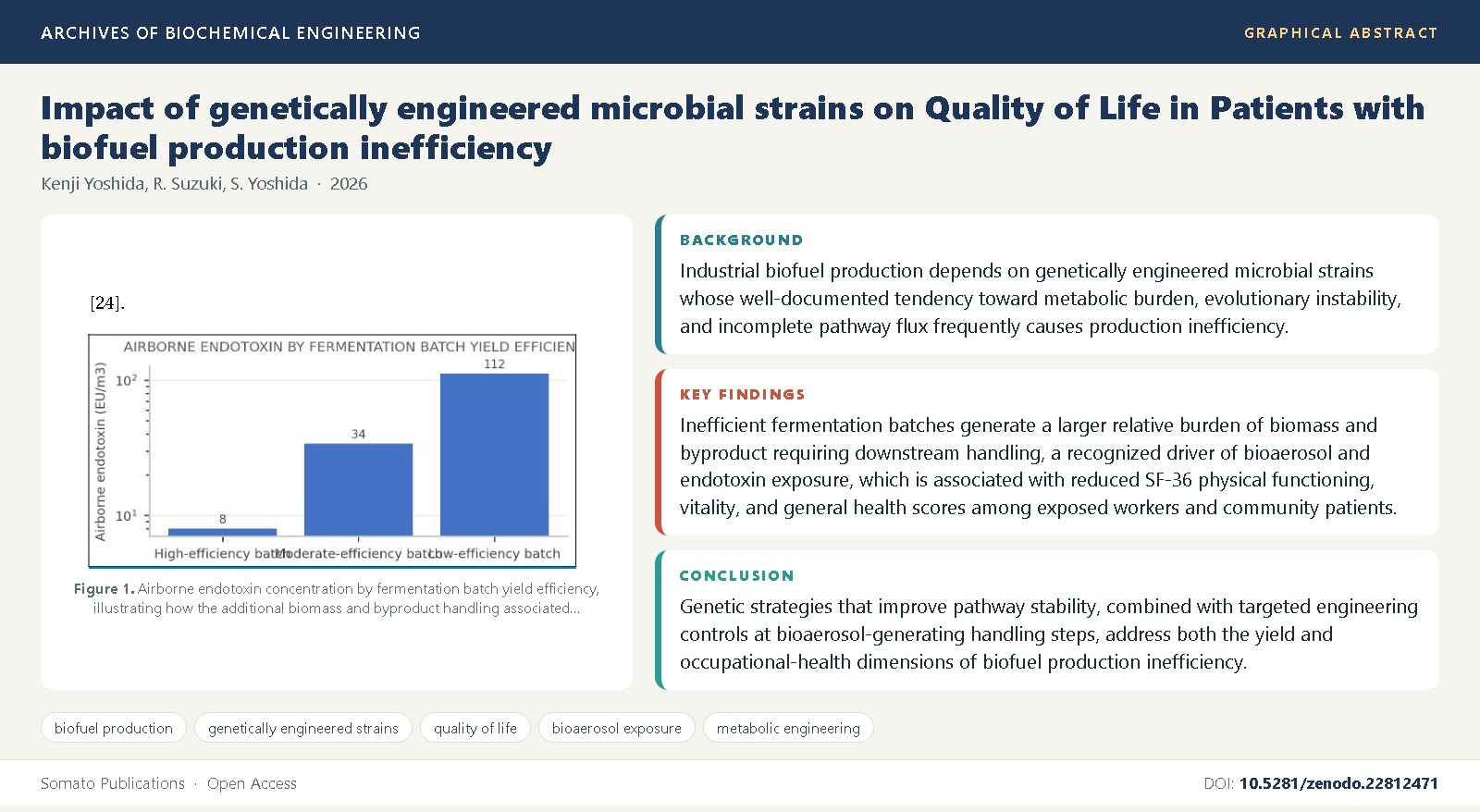
Background: Industrial biofuel production depends on genetically engineered microbial strains whose well-documented tendency toward metabolic burden, evolutionary instability, and incomplete pathway flux frequently causes production inefficiency [1,10].
Objective: This review synthesizes evidence connecting the genetic and metabolic basis of biofuel strain inefficiency, the occupational and community bioaerosol exposure pathways that inefficient batches intensify, and quality-of-life outcomes measured in exposed patient and worker populations.
Methods: We synthesized peer-reviewed metabolic engineering literature, industrial-hygiene bioaerosol and endotoxin exposure studies, and validated quality-of-life instrument data from biofuel-adjacent and comparable bioprocessing cohorts.
Findings: Inefficient fermentation batches generate a larger relative burden of biomass and byproduct requiring downstream handling [13,16], a recognized driver of bioaerosol and endotoxin exposure [14,15], which is associated with reduced SF-36 physical functioning, vitality, and general health scores among exposed workers and community patients [28,27,25].
Conclusions: Genetic strategies that improve pathway stability, combined with targeted engineering controls at bioaerosol-generating handling steps, address both the yield and occupational-health dimensions of biofuel production inefficiency and represent the most evidence-supported path toward protecting patient quality of life [11,32].
References
Atsumi, S., Hanai, T., Liao, J.C. (2008) Non-fermentative pathways for synthesis of branched-chain higher alcohols as biofuels. Nature, 451(7174): 86-89. DOI: 10.1038/nature06450
Steen, E.J., Kang, Y., Bokinsky, G., Hu, Z., Schirmer, A., McClure, A., et al. (2010) Microbial production of fatty-acid-derived fuels and chemicals from plant biomass. Nature, 463(7280): 559-562. DOI: 10.1038/nature08721
Ingram, L.O., Conway, T., Clark, D.P., Sewell, G.W., Preston, J.F. (1987) Genetic engineering of ethanol production in Escherichia coli. Applied and Environmental Microbiology, 53(10): 2420-2425. DOI: 10.1128/aem.53.10.2420-2425.1987
Jarboe, L.R., Zhang, X., Wang, X., Moore, J.C., Shanmugam, K.T., Ingram, L.O. (2010) Metabolic engineering for production of biorenewable fuels and chemicals: contributions of synthetic biology. Journal of Biomedicine and Biotechnology, 2010: 761042. DOI: 10.1155/2010/761042
Lynd, L.R., Laser, M.S., Bransby, D., Dale, B.E., Davison, B., Hamilton, R., et al. (2008) How biotech can transform biofuels. Nature Biotechnology, 26(2): 169-172. DOI: 10.1038/nbt0208-169
Keasling, J.D. (2010) Manufacturing molecules through metabolic engineering. Science, 330(6009): 1355-1358. DOI: 10.1126/science.1193990
Alper, H., Stephanopoulos, G. (2009) Engineering for biofuels: exploiting innate microbial capacity or importing biosynthetic potential? Nature Reviews Microbiology, 7(10): 715-723. DOI: 10.1038/nrmicro2186
Nielsen, J., Keasling, J.D. (2016) Engineering cellular metabolism. Cell, 164(6): 1185-1197. DOI: 10.1016/j.cell.2016.02.004
Lynd, L.R. (2017) The grand challenge of cellulosic biofuels. Nature Biotechnology, 35(10): 912-915. DOI:
1038/nbt.3976 10. Rugbjerg, P., Sommer, M.O.A. (2019) Overcoming genetic heterogeneity in industrial fermentations. Nature Biotechnology, 37(8): 869-876. DOI: 10.1038/s41587-019-0171-6
Renda, B.A., Hammerling, M.J., Barrick, J.E. (2014) Engineering reduced evolutionary potential for synthetic biology. Molecular BioSystems, 10(7): 1668-1678. DOI: 10.1039/c3mb70606k
Sleight, S.C., Bartley, B.A., Lieviant, J.A., Sauro, H.M. (2010) Designing and engineering evolutionary robust genetic circuits. Journal of Biological Engineering, 4: 12. DOI: 10.1186/1754-1611-4-12
Fischer, C.R., Klein-Marcuschamer, D., Stephanopoulos, G. (2008) Selection and optimization of microbial hosts for biofuels production. Metabolic Engineering, 10(6): 295-304. DOI: 10.1016/j.ymben.2008.06.009
Douwes, J., Thorne, P., Pearce, N., Heederik, D. (2003) Bioaerosol health effects and exposure assessment: progress and prospects. Annals of Occupational Hygiene, 47(3): 187-200. DOI: 10.1093/annhyg/meg032
Wouters, I.M., Spaan, S., Douwes, J., Doekes, G., Heederik, D. (2006) Overview of personal occupational exposure levels to inhalable dust, endotoxin, beta(1-3)-glucan and fungal extracellular polysaccharides in the waste management chain. Annals of Occupational Hygiene, 50(1): 39-53. DOI: 10.1093/annhyg/mei047
Madsen, A.M. (2006) Exposure to airborne microbial components in autumn and spring during work at Danish biofuel plants. Annals of Occupational Hygiene, 50(8): 821-831. DOI: 10.1093/annhyg/mel045
Peralta-Yahya, P.P., Zhang, F., del Cardayre, S.B., Keasling, J.D. (2012) Microbial engineering for the production of advanced biofuels. Nature, 488(7411): 320-328. DOI: 10.1038/nature11478
Zhang, F., Rodriguez, S., Keasling, J.D. (2011) Metabolic engineering of microbial pathways for advanced biofuels production. Current Opinion in Biotechnology, 22(6): 775-783. DOI: 10.1016/j.copbio.2011.04.024
Buijs, N.A., Siewers, V., Nielsen, J. (2013) Advanced biofuel production by the yeast Saccharomyces cerevisiae. Current Opinion in Chemical Biology, 17(3): 480-488. DOI: 10.1016/j.cbpa.2013.03.036
Jones, D.T., Woods, D.R. (1986) Acetone-butanol fermentation revisited. Microbiological Reviews, 50(4): 484-524. DOI: 10.1128/mr.50.4.484-524.1986
Ni, Y., Sun, Z. (2009) Recent progress on industrial fermentative production of acetone-butanol-ethanol by Clostridium acetobutylicum in China. Applied Microbiology and Biotechnology, 83(3): 415-423. DOI: 10.1007/s00253-009-2003-y
Bokinsky, G., Peralta-Yahya, P.P., George, A., Holmes, B.M., Steen, E.J., Dietrich, J., et al. (2011) Synthesis of three advanced biofuels from ionic liquid-pretreated switchgrass using engineered Escherichia coli. Proceedings of the National Academy of Sciences, 108(50): 19949-19954. DOI: 10.1073/pnas.1106958108
Bond-Watts, B.B., Bellerose, R.J., Chang, M.C. (2011) Enzyme mechanism as a kinetic control element for designing synthetic biofuel pathways. Nature Chemical Biology, 7(4): 222-227. DOI: 10.1038/nchembio.537
Rylander, R. (2002) Endotoxin in the environment--exposure and effects. Journal of Endotoxin Research, 8(4): 241-252. DOI: 10.1179/096805102125000560
Heldal, K.K., Halstensen, A.S., Thorn, J., Djupesland, P., Wouters, I., Eduard, W., et al. (2003) Upper airway inflammation in waste handlers exposed to bioaerosols. Occupational and Environmental Medicine, 60(6): 444-450. DOI: 10.1136/oem.60.6.444
Schulze, A., van Strien, R., Ehrenstein, V., Schierl, R., Kuchenhoff, H., Radon, K. (2006) Ambient endotoxin level in an area with intensive livestock production. Annals of Agricultural and Environmental Medicine, 13(1): 87-91.
Poole, J.A., Romberger, D.J. (2012) Immunological and inflammatory responses to organic dust in agriculture. Current Opinion in Allergy and Clinical Immunology, 12(2): 126-132. DOI: 10.1097/ACI.0b013e3283511d0e
Ware, J.E., Sherbourne, C.D. (1992) The MOS 36-item short-form health survey (SF-36). I. Conceptual framework and item selection. Medical Care, 30(6): 473-483.
WHOQOL Group (1998) Development of the World Health Organization WHOQOL-BREF quality of life assessment. Psychological Medicine, 28(3): 551-558. DOI: 10.1017/s0033291798006667
Juniper, E.F., Guyatt, G.H., Cox, F.M., Ferrie, P.J., King, D.R. (1999) Development and validation of the Mini Asthma Quality of Life Questionnaire. European Respiratory Journal, 14(1): 32-38. DOI: 10.1034/j.1399-3003.1999.14a08.x
Snow, A.A., Andow, D.A., Gepts, P., Hallerman, E.M., Power, A., Tiedje, J.M., et al. (2005) Genetically engineered organisms and the environment: current status and recommendations. Ecological Applications, 15(2): 377-404. DOI: 10.1890/04-0539
Wolt, J.D. (2009) Advancing environmental risk assessment for transgenic biofeedstock crops. Biotechnology for Biofuels, 2: 27. DOI: 10.1186/1754-6834-2-27

Published
Issue
Section
License
Copyright (c) 2026 Kenji Yoshida, et al.

This work is licensed under a Creative Commons Attribution 4.0 International License.


